Import

New Section 232 Action: What the June 2026 Aluminum, Steel & Copper Proclamation Means for Your Imports

Topline summary: On June 1, 2026, President Trump amended the Section 232 tariff framework for aluminum, steel, and copper. Importers of agricultural, industrial, and mobile equipment may qualify for temporarily reduced rates of 10–15%, while certain furniture parts, lithographic plates, and steel racks are newly dutiable for the first time. With a December 31, 2027, sunset on all temporary reductions, importers should audit their HTS classifications now to avoid overpaying or underpaying.

On June 1, 2026, the President issued Proclamation 11032, “Further Adjusting the Tariff Regimes for Imports of Aluminum, Steel, and Copper Into the United States,” amending the April 2026 Section 232 framework (Proclamation 11021). U.S. Customs and Border Protection (CBP) followed on June 5 with implementation guidance in CSMS #68855869. The changes take effect for goods entered for consumption, or withdrawn from a warehouse for consumption, on or after 12:01 a.m. ET on June 8, 2026. 

This is not a uniform tariff cut. The proclamation does two opposite things at once. It reduces Section 232 rates on a large block of machinery and equipment, while simultaneously adding new products to the duty regime for the first time. If you import equipment, the change may help you. If you import certain furniture parts, lithographic plates, or steel racks, you may have just become newly dutiable.  

What Changed on June 8 

  1. New products […]

FTC Cracks Down on False “Made in the USA” Claims 

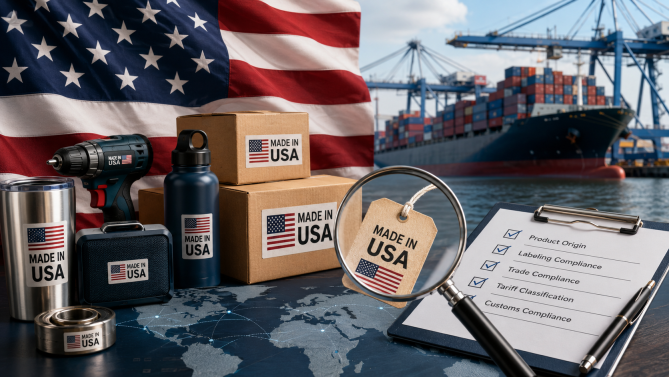
The Federal Trade Commission (FTC) recently announced law enforcement actions involving three companies that falsely claimed that their products were made in the United States.  

Made in the USA

The “Made in the USA” labeling rules were enacted to prevent deceptive advertising and ensure customers can make informed purchasing choices. The concept of labeling products with the correct country of origin dates all the way back to the McKinley Tariff Act in 1890, and Congress and federal agencies have updated “Made in the USA” rules over the years.  

FTC Jurisdiction 

The FTC is charged with preventing deception and unfairness in the marketplace. Under the FTC Act, the Commission may bring legal action against “false or misleading claims that a product is of U.S. origin”. The agency is authorized to issue a civil penalty of up to $40,654 per violation. 

The FTC has issued guidance on complying with the “Made in the USA” standard, most recently in 2021. View the latest guidance here.

When Can I Say Made in the USA? 

For a product to be considered as “Made in the USA” without qualification, that product must be “all or virtually all” made in the U.S. How the Commission determines whether a product is “all or virtually all” made in the U.S. is by looking at whether there was “a ‘reasonable basis’ to support the claim at the time it is made”. To prove […]

FDA Announces One-Day Inspection Pilot

The U.S. Food and Drug Administration (FDA) announced that it is piloting one-day inspectional assessments. These assessments will be shorter, more focused, and will complement existing standard FDA inspections.  

Shorter Inspections, More Coverage 

Launched in April 2026, the pilot is part of a broader initiative to make the agency’s inspectional resources more targeted and efficient. The new assessments will allow for broader coverage, enabling the agency to assess more facilities without compromising regulatory rigor. 

The pilot is being conducted across multiple FDA inspectorates, including human and animal foods, biologics, medical products, and clinical research programs. Facilities are selected using risk-based criteria such as:  

  • Product type 
  • Prior inspection outcomes 
  • Operational characteristics  

As of late April 2026, the FDA has completed approximately 46 one-day assessments.  

The agency made clear that one-day inspectional assessments are not intended to replace standard FDA inspections. Instead, they are meant to provide an additional tool to the agency’s enforcement approach. The ‘one-day’ framework is also flexible – investigators retain authority to expand the scope or duration of an assessment if warranted.  

The pilot will continue through fiscal year 2026. The FDA is currently developing evaluation metrics to assess effectiveness, including inspection duration, escalation rates, and the utility of findings in informing risk-based decision-making. 

What Facility Owners and Operators Should Do 

Facility owners and operators should remain ready […]

The Largest Customs Fraud Settlement from the DOJ Trade Fraud Task Force: $549.5 Million and What This Means for Importers 

On May 12, 2026, the Department of Justice announced one of the largest customs fraud settlements in U.S. history. Perfectus Aluminum Inc., Perfectus Aluminum Acquisitions LLC, and four affiliated warehousing companies (“the Defendants”) agreed to pay $549.5 million to resolve False Claims Act (“FCA”) allegations that they knowingly evaded antidumping and countervailing duties on aluminum extrusions imported from China. 

The Scheme: Pallets That Weren’t Pallets 

The underlying conduct was relatively simple. According to the Settlement Agreement, between July 2011 and June 2014, the Defendants knowingly made false statements on CBP Form 7501 Entry Summaries, misrepresenting more than 2.2 million aluminum extrusions as finished merchandise not subject to antidumping and countervailing duties. The mechanism? The extrusions were spot-welded together to make them appear to be functional pallets — and there were no actual customers for these “pallets.” So, no merchandise was ever actually sold. 

Criminal Conviction Came First 

This civil settlement did not arise in a vacuum. In August 2021, a jury in the Central District of California convicted the Defendants of conspiracy to defraud the United States, wire fraud, and passing false or fraudulent documents through a customs house. Following sentencing, the defendants were ordered to pay restitution of approximately $1.83 billion to CBP. The May 2026 FCA settlement resolves the parallel civil litigation arising from the same conduct. Importantly, this civil resolution does not absolve the defendants from any criminal liability outlined in […]

Commerce Releases Applications for Onshoring Agreements to Reduce Section 232 Tariffs

On May 11, 2026, the U.S. Department of Commerce published the procedures for companies to apply for agreements with the U.S. government to reduce Section 232 tariffs on imported patented pharmaceutical products by onshoring manufacturing.

Section 232 Background 

On April 2, 2026, President Trump issued a proclamation imposing Section 232 tariffs on certain pharmaceutical products imported into the United States. Section 232 authorizes the president to adjust imports to address national security threats. In the proclamation, the President stated that the U.S.’s reliance on imports of pharmaceuticals has created fragile supply chains, threatening national security.

President Trump imposed a 100% tariff on certain patented pharmaceuticals and their associated ingredients. The tariffs will take effect for certain large companies on July 31, 2026, and for small companies on September 29, 2026.

The proclamation also included several carveouts. For example, Companies that have entered into qualifying agreements with the US government and developed plans to onshore production of patented pharmaceuticals and associated ingredients will be subject to only a 20% tariff from September 29, 2026, through April 2, 2030. 

Onshoring Agreement Application Process

On May 11, 2026, Commerce published procedures for companies to apply for Onshoring Agreements that would qualify them for the reduced 20% tariff. 

Applications must include: 

  • Organization Information: Full legal name, address, ownership structure, and beneficial ownership, including the country where the company’s headquarters is located.
Go to Top