penalty

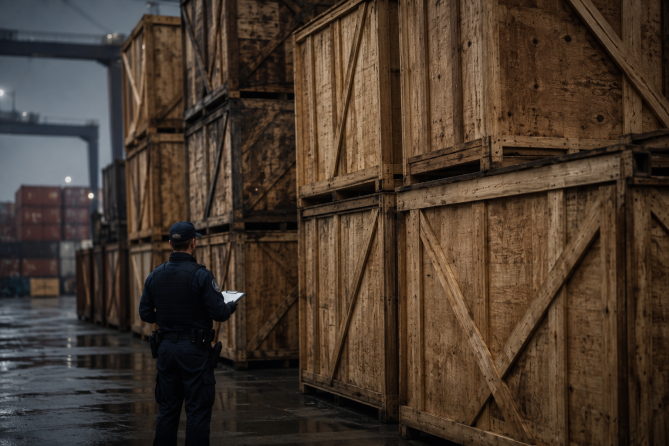
Wood Packaging Material Violations: What to Do When CBP Issues an EAN 

This article explains what an importer should do in the first 24 hours after CBP issues an Emergency Action Notification (EAN) for non-compliant wood packaging material (WPM), how CBP calculates and mitigates the penalties that follow, and how the new APHIS-approved shredder-hammermill treatment can save the underlying cargo. It matters because a WPM penalty is assessed at the full domestic value of the merchandise, requires no pre-penalty notice, and can be issued even when the importer fully complies with the EAN. The decisions made before the cargo leaves the port determine how much of that exposure survives. 

KEY TAKEAWAYS 

  • An Emergency Action Notification (EAN) for non-compliant wood packaging material is not the end of the matter. It is the start of a penalty file. Call counsel the day it arrives, not the day the penalty notice arrives. 
  • CBP penalties for WPM violations are assessed at the domestic value of the merchandise under 19 U.S.C. § 1595a(b), with no pre-penalty notice required. A single violation is enough. The old five-violation threshold was eliminated in 2017. 
  • Mitigation is real but shrinks fast: 1 to 10 percent of the penalty on a first violation, 10 to 25 percent on a second, and a 25 percent floor on the third. Documented immediate remediation and cooperation are what move you toward the low end. 
  • Shredder-hammermilling is now an APHIS-approved treatment for non-compliant […]

ICYMI: Patio Furniture Company Agrees to Pay $4.9 Million to Resolve Duty Evasion Allegations

On July 24, 2025, the Department of Justice (DoJ) announced that Grosfillex, Inc., a Pennsylvania furniture company, agreed to pay $4.9 million to resolve allegations it evaded antidumping and countervailing duties (AD/CVD).

Grosfillex submitted false forms to Customs and Border Protection (CBP) claiming that furniture parts made of extruded aluminum from China were not subject to AD/CVD. The company attempted to hide the aluminum extrusions by falsely packing them as sham “furniture kits.” Additionally, for a different subset of extrusions, the company failed to correct customs forms it had submitted previously, even after learning that the forms contained false information.

The investigation arose from a whistleblower lawsuit filed under the False Claims Act by a former employee of Grosfillex. Under the False Claims Act, private citizens can sue on behalf of the government and share in any recovery. In this case, the whistleblower will receive $962,662.74.

Duty Evasion is on the Rise

This case is just one example of the growing incentive to cheat that comes with higher tariffs. Whether it’s through misclassifying goods, undervaluing imports, or using deceptive transshipment routes, some companies think they are being creative, but, instead, are participating in outright illegal strategies to reduce their tariff liability.

Higher tariffs have even contributed to the emergence of a cottage industry of “tariff reduction” companies that suggest ways to cut import costs. However, many of these so-called strategies amount to evasion, […]

CIT Hands Down $3.4M Penalty for Duty Evasion

On July 18, 2025, the Court of International Trade (CIT) granted the government’s motion for default judgment against importer Rayson Global and its owner, Doris Cheng, for negligently failing to pay duties. 

The Case

The government’s case was filed in 2023, alleging that the importers had falsely declared that Chinese-origin goods as Thai origin to evade duties. The government asserted this false declaration avoided payment of ordinary 6% duties, Section 301 duties ranging from 10% to 25%, and 234.51% antidumping duties. 

The government asked the court to impose a penalty for negligence. The penalty amount is twice the loss of revenue or the domestic value, whichever is lower. After the importer failed to answer the complaint (a huge mistake), the U.S. moved for summary judgment.

The CIT granted the government’s motion and ordered the importer to pay a nearly $3.4 million penalty as well as all unpaid duties, taxes, and cash deposits on the unliquidated entries in question.

Duty Evasion is on the Rise

This case is just one example of the growing incentive to cheat that comes with higher tariffs. Whether it’s through misclassifying goods, undervaluing imports, or using deceptive transshipment routes, some companies are turning to creative or outright illegal strategies to reduce their tariff liability.

These incentives have even contributed to the emergence of a cottage industry of “tariff reduction” companies that suggest ways to cut import costs. However, many of these so-called strategies amount […]

Ford Motor Company Settles Claims Relating to Under-Valued Vehicles for $365M

Ford Motor Company has agreed to pay $365 million for allegedly misclassifying and understating the value of hundreds of thousands of vehicles.

According to the Department of Justice, Ford engaged in a scheme to avoid higher duties by misclassifying cargo vans. Between 2009 and 2013, the company imported Transit Connect cargo vans into the United States but presented them to Customs and Border Protection (CBP) with temporary seats and other features to make them appear to be passenger vehicles. The seats were never intended to carry passengers and Ford removed them as part of post-importation processing. The inclusion of the seats allowed Ford to avoid paying the 25% duty rate for cargo vehicles and instead they paid a duty rate of just 2.5%.

This case dates back to February 2012 when the Port of Baltimore advised Ford it was initiating an investigation into Ford’s classification practices. (Typically, prior to investigating an entity, CBP sends a request for information first. For more information on how this process typically begins read “Now, More than Ever, Be Wary of and Responsive to a CBP Form 28!”).

In 2013 Customs determined that the vans were improperly classified and liquidated the vehicles at the 25% duty rate. Ford protested, and Customs denied the protest. Ford then filed a complaint with the U.S. Court of International Trade (CIT). The CIT agreed with Ford, finding that Ford engaged in legitimate tariff engineering. The government appealed to the United States Court of Appeals for the Federal Circuit where […]

By |2024-03-15T14:49:39-04:00March 15, 2024|Import, penalty|0 Comments

Clothing Wholesaler Executive Avoids Paying Millions in Duties – Sentenced to 4 Years in Prison

Mohamed Daoud Ghacham, a 40-year-old executive from California has been sentenced to 48-months in prison for customs fraud. Ghacham, who was at the helm of a Paramount-based clothing wholesale company, engaged in a deceitful scheme that allowed his business to sidestep paying millions in customs duties on imported garments.

United States District Judge Maame Ewusi-Mensah Frimpong handed down the sentence, which also includes a restitution payment of $6,390,781.

The fraudulent operation involved importing clothing from China and presenting U.S. Customs and Border Protection (CBP) with a fraudulent second invoice with a lowered value. At Ghacham’s direction, Chinese suppliers would prepare two invoices for orders – a true invoice with the actual price paid and a fraudulent invoice with an understated price. Ghacham submitted the false invoices to CBP, allowing them to avoid millions of dollars in duties for over a decade.

Ghacham also faced charges related to conspiring to engage in transactions with a known narcotics trafficker.

The sentencing of Ghacham and his company concludes a comprehensive investigation by Homeland Security Investigations and CBP, with assistance from the U.S. Department of Commerce Office of Export Enforcement, the Treasury Department’s Office of Foreign Assets Control, and IRS Criminal Investigation.

This case underscores the U.S. government’s unwavering commitment to enforcing its customs laws and the severe consequences for those who choose to circumvent them.

Interested in learning more about CBP enforcement? Check out our upcoming webinar on the False Claims Act (FCA). We will discuss damages and criminal liability for making false claims to the government, whistleblower […]

By |2024-03-15T14:25:27-04:00March 15, 2024|Import, penalty|0 Comments
Go to Top