April 2026

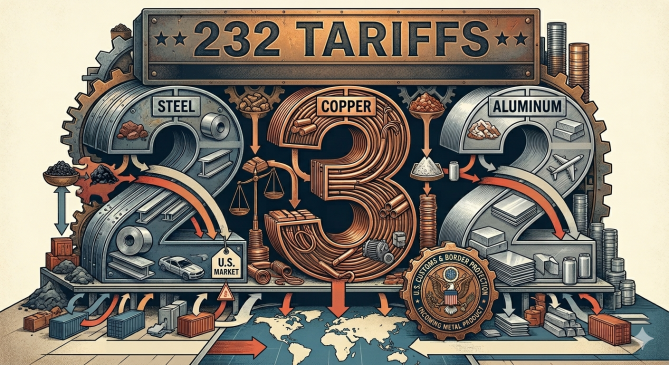
Department of Commerce Issues New Duty-Free Code for 232 Tariffs 

On April 27, 2026, the Department of Commerce published a Federal Register notice adding a new duty-free code in the Harmonized Tariff Schedule of the United States (HTSUS). The addition resolves a discrepancy for goods classified under HTSUS Chapters for steel, aluminum, and copper that were subject to 232 tariff classification even though they did not contain any of these elements. The provision, subheading 9903.82, applies retroactively to April 6, 2026. 

Recent 232 Developments 

This notice is the latest in a series of adjustments to 232 tariffs on steel, copper, iron, and aluminum.  

On April 2, 2026, the President issued a proclamation strengthening Section 232 actions to adjust imports of aluminum, steel, and copper, continuing to cite national security concerns and the need to reinforce domestic metals industries. Key elements of the proclamation include: a tiered tariff structure and some products exempt from Sec. 232 tariffs, and manufacturing drawback claims. Read more here. 

CBP has attempted to help importers navigate 232 tariffs. The agency recently published  FAQs and CSMS messages on steel and aluminum about how to calculate and report the value of the steel and aluminum content of steel and aluminum derivative articles.  

232 has been a hot topic at the Court of International Trade (CIT) as well. There is a current case challenging how CBP has been valuing and […]

By |2026-04-30T11:25:15-04:00April 30, 2026|Import, tariffs|0 Comments

Breaking Trade News: CBP Launches CAPE Phase 1, USMCA Talks Continue, OFAC Sanctions

Here is a recap of the latest customs and international trade law news:      

Administration   

  • In an interview with CNBC, President Trump commented about the difficulty in facilitating IEEPA refunds and suggested that he would remember companies that choose not to seek refunds. 

Customs and Border Protection (CBP)   

  • On April 20, CBP launched Phase 1 of the Consolidated Administration and Processing of Entries (CAPE). Importers of record (IORs) and licensed customs brokers may now file CAPE Declarations through ACE. 
  • CBP officers at Port Everglades seized 8,500 units of counterfeit designer perfumes, which would have been valued at over $1 million had they been genuine. 

Court of International Trade (CIT)   

  • CIT Judge Eaton ordered the government to file a report on the progress made during CAPE Phase One by April 28.  

U.S. Department of Commerce 

  • The Commerce Department published a notice outlining procedures for requesting tariff breaks on Canadian and Mexican steel and aluminum used to produce U.S. cars, trucks, and parts. 
  • In a budget request document, the Commerce Department referred to a Section 232 investigation that has not been publicly […]
By |2026-04-24T12:13:31-04:00April 24, 2026|news, Snapshot|0 Comments

CAPE Phase 1 is Here

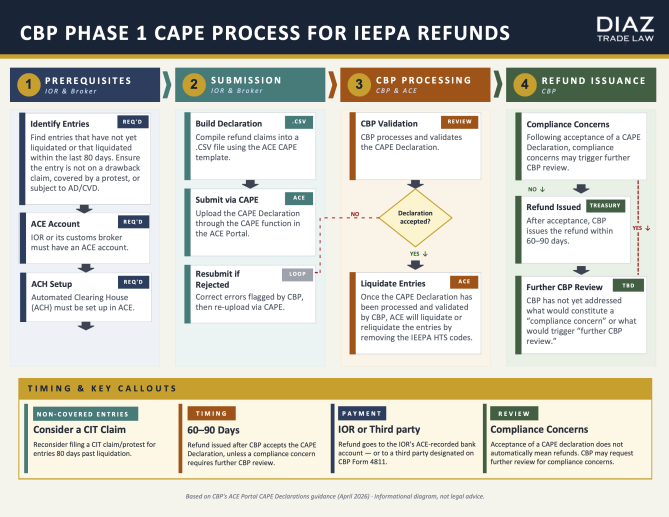
On April 20, 2026, CBP launched Phase 1 of the Consolidated Administration and Processing of Entries (CAPE). Importers of record (IORs) and licensed customs brokers may now file CAPE Declarations through ACE.

Tariff Refund Process

CBP has specified the actions required for requesting refunds:

  1. The Importer of Record (IOR) or its customs broker must have an ACE account.
  2. ACH must be set up in ACE (using a U.S. bank account).
  3. The IOR or its customs broker must submit the request for refund (CAPE Declaration) via CAPE in the ACE system.

The CAPE Declaration must be submitted as a .CSV file in ACE along with the following certification:

“I attest to the best of my knowledge and belief that: (1) the country of origin, entry type, Harmonized Tariff Schedule of the United States (HTSUS) classification(s), and valuation for each entry number is true and correct; and (2) the goods were not entered in violation of any applicable United States law, order, or rule. I understand that if I make or cause others to make material false statements or omissions to CBP, including in connection with a request for tariff reimbursement, I may be subject to criminal prosecution and civil liability, including but not limited to under 18 U.S.C. §§ 1001, 542, 545, 19 USC § 1592, and 31 U.S.C. § 3729(a).”

Once the CAPE Declaration has been processed and validated by CBP, ACE will liquidate or reliquidate the entries by removing the IEEPA HTS codes.  Refunds will be issued directly to the IOR’s bank account recorded in ACE or to a party the IOR has designated to receive refunds on its behalf via CBP Form 4811. Lastly, after the CAPE […]

By |2026-04-23T13:04:08-04:00April 23, 2026|tariffs|0 Comments

Breaking Trade News: IEEPA Refunds Update, Section 122 Hearing, Upcoming 301 Tariffs

Here is a recap of the latest customs and international trade law news:     

Administration  

  • In a statement to the Wall Street Journal, Treasury Secretary Scott Bessent said that tariffs could return to levels in place under IEEPA by the beginning of July through the use of Section 301. 

Customs and Border Protection (CBP)  

  • CBP filed a declaration with the CIT providing an update on the agency’s progress in facilitating IEEPA tariff refunds via CAPE. As of April 14, 2026, CBP has completed all the primary components and functionalities for Phase 1 and will begin accepting refund requests on April 20, 2026. 
  • CBP released a CSMS message guiding importers seeking IEEPA refunds via CAPE. The message includes guidance on submitting CAPE declarations and provides additional detail on the process CBP will follow in processing requests. 
  • CBP sent a trade bulletin reminding importers to sign up for an ACE portal account so that they may receive electronic refunds from CBP. 
  • CBP officers at the Buffalo port of entry seized nearly 1,000 electronic devices bearing counterfeit trademarks that, if authentic, would have been worth about $150,000. 
By |2026-04-17T12:36:31-04:00April 17, 2026|news, Snapshot|0 Comments

Tariff and Macroeconomic Risk Disclosures:

Lessons from Recent Shareholder Litigation Against Dow and Tronox

Authors:  

Jennifer Diaz, President, Diaz Trade Law
Amber Pirson, Attorney, Diaz Trade Law 

Recent securities class actions against Dow Inc. and Tronox Holdings plc underscore the growing litigation risk associated with tariff‑related and broader economic disclosures in periodic reports, earnings calls, and investor communications. These cases highlight how shareholder plaintiffs are scrutinizing statements that characterize tariffs and related headwinds as manageable, temporary, or hypothetical when subsequent developments suggest a more pronounced or foreseeable impact. 

As public companies continue to navigate volatile trade policy, supply chain disruption, and demand uncertainty, these lawsuits provide concrete guidance on how the SEC’s disclosure framework—particularly risk factors and Management’s Discussion and Analysis (MD&A) “known trends” disclosures—may be applied in hindsight by regulators and private litigants. 

Regulatory Framework: Risk Factors and Known Trends 

SEC rules make clear that companies must disclose certain risks to investors. For example, Item 105 of Regulation S‑K requires companies to disclose material risks that make an investment speculative or risky, while Item 303 requires MD&A discussion of known trends, events, or uncertainties reasonably likely to have a material impact on financial condition or operating results. In this context, tariffs – particularly where they affect costs, pricing, demand, or dividends – have increasingly been viewed as classic “known trends,” rather than contingent or […]

Go to Top