July 2026

What Happened This Month in International Trade (July 2026)

Another busy month in international trade news. Here’s the roundup: 

Administration:

  • President Trump issued a Proclamation establishing an incentive for companies that are expanding primary aluminum production in the US, allowing them to import primary aluminum at a reduced tariff rate. 
  • On July 20, 2026, the White House announced that the United States will impose an additional 50% tariff on many Canadian-origin products beginning 30 days after the order’s issuance.  
  • President Trump announced via Truth Social that the Administration will initiate a 301 investigation into the European Union for excessive fines against American tech companies. 
  • President Trump announced via Truth Social that effective August 1st, 2026, all Generic Drugs being brought into the United States will continue to have a 0% tariff for a two-year period of time, after which the tariff will be raised to 100% for one year, and 200% thereafter. 
United States Trade Representative (USTR)  

  • On July 23, 2026, the USTR announced a Section 301 action imposing new tariffs on 60 trading partners.  
  • On July 15, 2025, the USTR announced a Section 301 action imposing a 25% tariff against some Brazilian exports.  
  • The […]
By |2026-07-31T09:18:48-04:00July 31, 2026|news, Snapshot|0 Comments

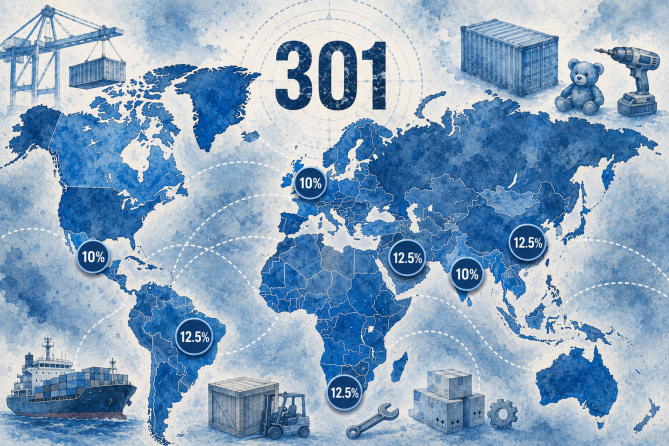
USTR Announces Section 301 Action Imposing New Tariffs on 60 Trading Partners 

The Office of the U.S. Trade Representative (USTR) has announced a new Section 301 action imposing additional tariffs of 10% to 12.5% on imports from 60 economies that fail to prohibit or effectively enforce bans on goods produced with forced labor. The action covers the top 60 U.S. trading partners, representing 99.4% of U.S. imports, and took effect July 24, 2026. U.S. Customs and Border Protection (CBP) has issued entry filing guidance in CSMS #69326983, including the applicable Chapter 99 tariff headings. 

Key Takeaways 

  • Effective July 24, 2026, USTR imposed additional Section 301 duties of 10% or 12.5% on imports from 60 economies covering 99.4% of U.S. imports, based on findings that these economies failed to adopt or effectively enforce forced labor import prohibitions. 
  • CBP issued entry filing instructions in CSMS #69326983, including the Chapter 99 headings (9903.05.20 through 9903.06.21), reporting sequence, and Foreign Trade Zone admission requirements. 
  • Goods entered duty free under USMCA (Canada and Mexico) are exempt, as are CAFTA-DR textiles and apparel, Section 232 articles, civil aircraft, pharmaceutical articles, informational materials, and donations. There is also a list of miscellaneous products exempt no matter what their country of origin. 
  • An in-transit exception applies to goods loaded and in transit on the final mode before 12:01 a.m. ET on July 24, 2026, and entered before 12:01 a.m. ET on July 28, 2026. 

Why USTR Took […]

CBP Protests and Post-Entry Corrections

Copyright 2025 Bloomberg Industry Group, Inc. (800-372-1033) Reproduced with permission. CBP Protests and Post-Entry Corrections

CBP is one of the most active federal enforcement bodies in international trade. CBP has broad authority to examine, detain, seize, and penalize imported goods, and it exercises that authority through an expanding set of tools.

Enforcement Mechanisms

CBP’s core enforcement mechanisms include:

  • Detention and Examination – Customs laws and regulations provide US Customs officers at all 328 ports of entry the ability to stop and search persons or merchandise and make admissibility decisions. Before goods are seized by CBP, they typically go through the detention process. CBP may detain any shipment for examination when it has reason to believe the goods may violate U.S. law.
  • Seizure and Forfeiture – When CBP suspects that goods violate U.S. law, it can seize the merchandise. The importer then faces a choice: file a petition for relief with CBP’s Fines, Penalties and Forfeitures Office (FP&F), offer a monetary settlement in lieu of forfeiture, abandon the goods, or contest the seizure through the administrative or judicial process.
  • Liquidation and Reliquidation – Every entry is subject to liquidation – the final determination of duties owed. CBP may liquidate an entry at a higher duty rate than originally estimated, triggering an unexpected duty bill. Importers have limited windows, generally within 180 days of liquidation, to challenge liquidation decisions.
  • Penalties – CBP has the authority to issue monetary penalties for violations of customs laws. These penalties may be assessed […]
By |2026-07-22T17:44:23-04:00July 22, 2026|Bloomberg Import|0 Comments

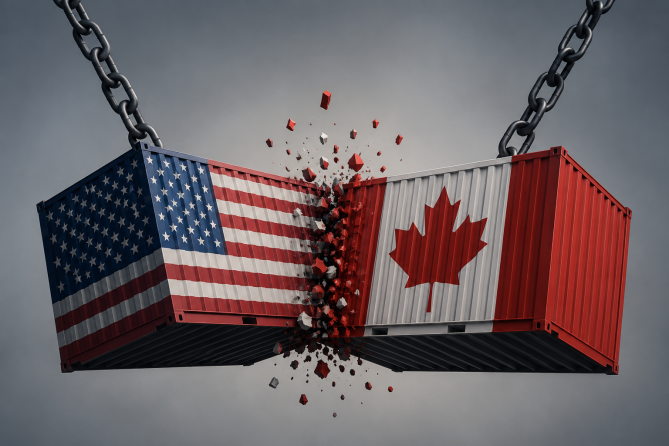
Trump Invokes Section 338 to Impose Additional Duties on Canadian Imports 

Short summary: The Trump Administration has announced new tariffs on Canadian imports and issued three presidential proclamations addressing Canada’s treatment of U.S. dairy products, alcoholic beverages, and motor vehicles. The actions rely on Section 338 of the Tariff Act of 1930 – a statutory authority that has remained largely unused for decades. 


On July 20, 2026, the Trump Administration published a fact sheet announcing new 50% tariffs on a broad range of Canadian imports. Simultaneously, the Administration issued three separate presidential proclamations targeting Canada’s treatment of U.S. dairy products, alcoholic beverages, and motor vehicles. According to the White House, these actions are intended to respond to what the Administration describes as Canada’s long-standing discrimination against U.S. commerce. 

The New Tariffs 

The White House announced that the United States will impose an additional 50% tariff on many Canadian-origin products beginning 30 days after the order’s issuance. According to the Administration, the new duties are intended to offset Canada’s alleged discriminatory treatment of American products and businesses. 

Products eligible for USMCA treatment are not exempt from the new tariffs. Several categories of goods are excluded from the new tariffs, including: 

  • Energy products 
  • Critical minerals 
  • Potash 
  • Fish 
By |2026-07-21T12:53:42-04:00July 21, 2026|Canada, International Trade, tariffs, USMCA|0 Comments

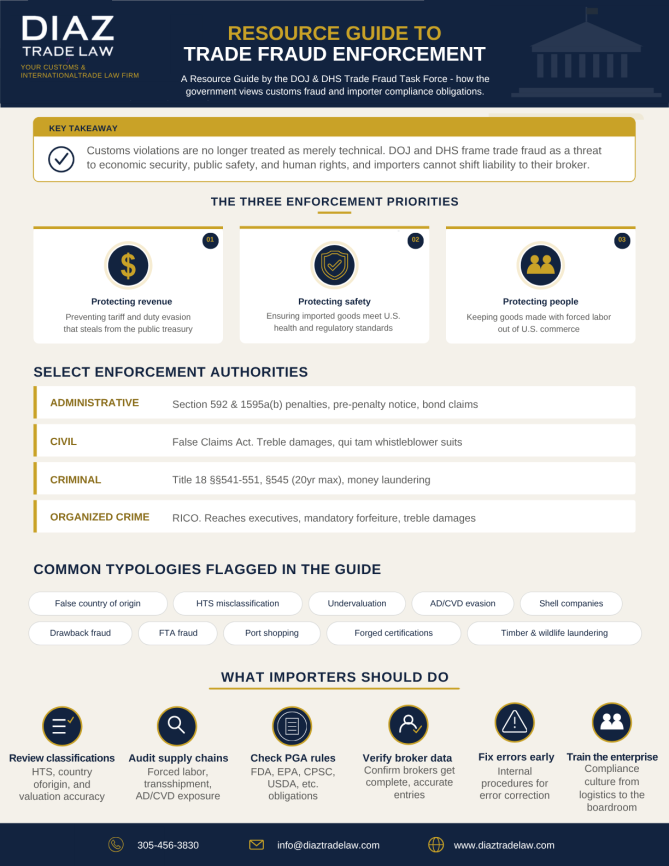
DOJ and DHS Publish Comprehensive Trade Fraud Enforcement Guide: What Importers Need to Know 

Short summary: The DOJ and DHS have jointly published a new Resource Guide to Trade Fraud Enforcement, highlighting the government’s coordinated approach to combating customs fraud and strengthening import compliance. The guide explains key enforcement authorities, common trade fraud schemes, and the government’s expectations for importers, customs brokers, and others participating in global supply chains.


The U.S. Department of Justice (DOJ) and Department of Homeland Security (DHS) have released a new 31-page Resource Guide to Trade Fraud Enforcement, providing one of the clearest public statements yet on how the federal government views customs fraud, enforcement priorities, and importer compliance obligations. The guide was developed by the Trade Fraud Task Force, a partnership that includes DOJ’s National Fraud Enforcement Division, Homeland Security Investigations (HSI), U.S. Customs and Border Protection (CBP), and other federal agencies. 

While much of the guide summarizes existing laws and enforcement authorities, its significance lies in the government’s messaging. It makes clear that customs violations are no longer viewed as merely technical or administrative issues. Instead, DOJ and DHS repeatedly characterize trade fraud as a threat to economic security, national security, public safety, and human rights, signaling that aggressive enforcement will continue across multiple agencies. 

Combatting Trade Fraud Is a Priority for the Federal Government 

One of the report’s primary themes is that trade fraud extends far beyond the underpayment of duties. According to the guide, fraudulent import practices undermine domestic manufacturers, deprive the government of […]

Go to Top