tariffs

New Section 232 Proclamation Targets Imports of Unmanned Aircraft Systems 

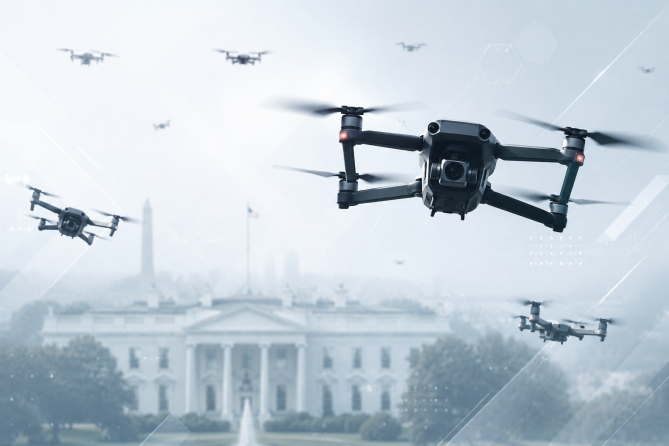
On August 13, 2026, President Trump issued a new proclamation under Section 232 of the Trade Expansion Act imposing tariffs on certain imported unmanned aircraft systems (UAS) and their components. The Administration concluded that the United States’ dependence on foreign-manufactured UAS and critical UAS components threatens to impair national security by limiting the domestic industrial base and creating vulnerabilities in critical supply chains. 

The proclamation follows a Section 232 investigation conducted by the Department of Commerce, which found that imports have outpaced domestic production and that the United States remains heavily reliant on foreign suppliers. The Administration also cited concerns surrounding cybersecurity, and dependence on unreliable supply chains. 

What Does the Proclamation Do? 

The proclamation establishes a new tariff framework based on the type of unmanned aircraft system, and, in some cases, the country of origin: 

  • 100% tariffs on UAS with a maximum take-off weight of more than 25 kg 
  • 100% tariffs on UAS that integrate thermal imagers  
  • 100% tariffs on UAS docking stations  
  • 100% tariffs on certain critical UAS components as identified in Annex I.  
  • 25% tariffs on UAS with a maximum take-off weight of 25 kilograms or less […]
By |2026-08-17T09:39:05-04:00August 16, 2026|tariffs|0 Comments

New Section 201 Safeguard Tariffs on Quartz Surface Products 

Short summary: President Trump’s new Section 201 safeguard measure establishes a four-year tariff-rate quota (TRQ) on imports of quartz surface products beginning August 15, 2026. While annual quota volumes gradually increase over the life of the measure, importers may face safeguard duties of up to 50% once quarterly quota allocations are exhausted, making careful planning essential.  

On July 31, 2026, President Trump issued a proclamation imposing a Section 201 safeguard measure on imports of quartz surface products (QSP). The measure takes the form of a four-year tariff-rate quota (TRQ) and applies to goods entered, or withdrawn from warehouse for consumption, on or after 12:01 a.m. Eastern Time on Saturday, August 15, 2026.   

If you import QSP, including countertops, backsplashes, vanity tops, bar tops, work tops, tabletops, flooring, wall facing, shower surrounds, fireplace surrounds, mantels, and tiles, this measure will likely affect your imports.  

How the Tariff-Rate Quota Works

A TRQ is not a flat tariff. A set volume of covered merchandise may enter each quota year at a lower in-quota rate under the new HTSUS heading 9903.45.30. Once that volume is exhausted, additional entries pay a substantially higher over-quota rate under new heading 9903.45.31.

The annual volume is divided into four equal quarterly tranches. Any unused portion of a quarterly tranche carries forward into the following quarter, and CBP is required to add the unused quantity to the next quarter’s total no later than 14 days after the prior quarter […]

By |2026-08-10T10:14:31-04:00August 8, 2026|tariffs|0 Comments

USTR Announces Section 301 Action Imposing New Tariffs on 60 Trading Partners 

The Office of the U.S. Trade Representative (USTR) has announced a new Section 301 action imposing additional tariffs of 10% to 12.5% on imports from 60 economies that fail to prohibit or effectively enforce bans on goods produced with forced labor. The action covers the top 60 U.S. trading partners, representing 99.4% of U.S. imports, and took effect July 24, 2026. U.S. Customs and Border Protection (CBP) has issued entry filing guidance in CSMS #69326983, including the applicable Chapter 99 tariff headings. 

Key Takeaways 

  • Effective July 24, 2026, USTR imposed additional Section 301 duties of 10% or 12.5% on imports from 60 economies covering 99.4% of U.S. imports, based on findings that these economies failed to adopt or effectively enforce forced labor import prohibitions. 
  • CBP issued entry filing instructions in CSMS #69326983, including the Chapter 99 headings (9903.05.20 through 9903.06.21), reporting sequence, and Foreign Trade Zone admission requirements. 
  • Goods entered duty free under USMCA (Canada and Mexico) are exempt, as are CAFTA-DR textiles and apparel, Section 232 articles, civil aircraft, pharmaceutical articles, informational materials, and donations. There is also a list of miscellaneous products exempt no matter what their country of origin. 
  • An in-transit exception applies to goods loaded and in transit on the final mode before 12:01 a.m. ET on July 24, 2026, and entered before 12:01 a.m. ET on July 28, 2026. 

Why USTR Took […]

Trump Invokes Section 338 to Impose Additional Duties on Canadian Imports 

Short summary: The Trump Administration has announced new tariffs on Canadian imports and issued three presidential proclamations addressing Canada’s treatment of U.S. dairy products, alcoholic beverages, and motor vehicles. The actions rely on Section 338 of the Tariff Act of 1930 – a statutory authority that has remained largely unused for decades. 


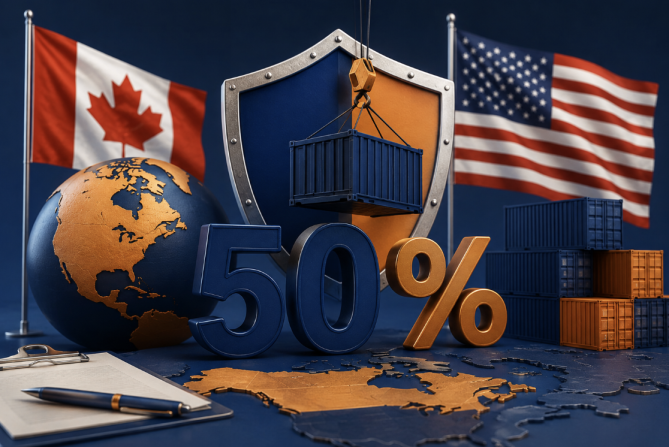
On July 20, 2026, the Trump Administration published a fact sheet announcing new 50% tariffs on a broad range of Canadian imports. Simultaneously, the Administration issued three separate presidential proclamations targeting Canada’s treatment of U.S. dairy products, alcoholic beverages, and motor vehicles. According to the White House, these actions are intended to respond to what the Administration describes as Canada’s long-standing discrimination against U.S. commerce. 

The New Tariffs 

The White House announced that the United States will impose an additional 50% tariff on many Canadian-origin products beginning 30 days after the order’s issuance. According to the Administration, the new duties are intended to offset Canada’s alleged discriminatory treatment of American products and businesses. 

Products eligible for USMCA treatment are not exempt from the new tariffs. Several categories of goods are excluded from the new tariffs, including: 

  • Energy products 
  • Critical minerals 
  • Potash 
  • Fish 
By |2026-07-21T12:53:42-04:00July 21, 2026|Canada, International Trade, tariffs, USMCA|0 Comments

IEEPA Tariff Refund Update: CIT Will Order Reliquidation of Some Finally Liquidated Entries 

Short summary: The U.S. Court of International Trade has announced that it plans to order U.S. Customs and Border Protection (CBP) to reliquidate certain finally liquidated entries in approximately 3,700 pending IEEPA tariff refund cases once CAPE Phase 3 launches. The court also confirmed that CBP continues to expand CAPE’s refund capabilities, including future functionality for entries with open protests, and provided an update on the billions of dollars in refunds already being processed. These developments represent another significant step toward resolving pending IEEPA tariff refund claims for importers. 


The U.S. Court of International Trade (CIT) has announced another significant development in the ongoing litigation over tariffs imposed under the International Emergency Economic Powers Act (IEEPA). In a July 15, 2026, order, Judge Richard K. Eaton confirmed that the court intends to direct U.S. Customs and Border Protection (CBP) to reliquidate certain finally liquidated entries in the approximately 3,700 pending CIT IEEPA refund cases once the next phase of CBP’s Consolidated Administration and Processing of Entries (CAPE) refund system becomes operational. 

While the order does not immediately authorize refunds of liquidated entries, it provides important insight into how the court and CBP plan to move thousands of pending refund claims toward resolution. 

Reliquidation Order Planned for Thousands of Cases 

The court stated that, in connection with the anticipated launch of CAPE Phase 3, it will issue an order directing CBP to reliquidate certain finally liquidated entries […]

Go to Top