Import

New AD/CVD Case Filed Against Stationary and Portable Air Compressors from China, Malaysia, and Vietnam 

A new antidumping and countervailing duty action has been filed against stationary and portable air compressors from China, Malaysia, and Vietnam. The allegation is that imports from China, Malaysia, and Vietnam are unfairly subsidized and are being dumped.  

Full list of importers here.  

Full list of exporters here.

Background on AD/CVD Investigations 

 Antidumping duty (“AD”) and countervailing duty (“CVD”) investigations are brought jointly by the U.S. International Trade Commission (“USITC”) and the U.S. Department of Commerce (“Commerce”). AD investigations are triggered when a domestic industry alleges that it has been injured by competing imports of particular goods from specific countries being sold at less than a fair value. Meanwhile, CVD investigations are triggered when a domestic industry alleges that it has been injured by competing imports that are being unfairly subsidized by their governments. The domestic industry initiating the investigation is known as the petitioner, while the foreign industry participating in the investigation is known as the respondent.

Scope of the Investigation  

The merchandise covered by these investigations is stationary and portable air compressors, electric, gas, and battery-powered.  

The products subject to the investigation are currently classified in the Harmonized Tariff Schedule of the United States (HTSUS) under the following subheadings: 8414.80.1615, 8414.80.1625, 8414.80.1635, and 8414.80.1685.  

Full scope here.

Next Steps 

The Commerce Department will determine whether to initiate the investigations within […]
Department of Commerce Issues New Duty-Free Code for 232 Tariffs 

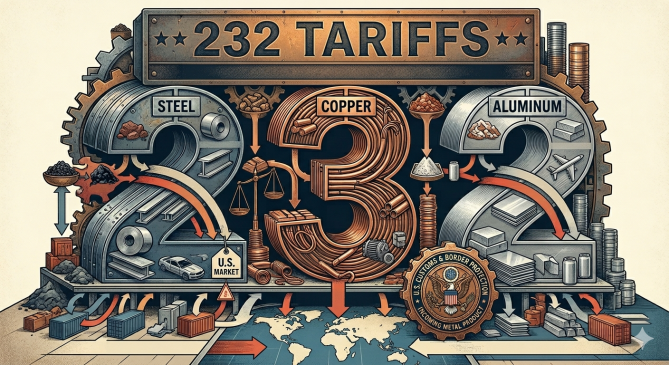
On April 27, 2026, the Department of Commerce published a Federal Register notice adding a new duty-free code in the Harmonized Tariff Schedule of the United States (HTSUS). The addition resolves a discrepancy for goods classified under HTSUS Chapters for steel, aluminum, and copper that were subject to 232 tariff classification even though they did not contain any of these elements. The provision, subheading 9903.82, applies retroactively to April 6, 2026. 

Recent 232 Developments 

This notice is the latest in a series of adjustments to 232 tariffs on steel, copper, iron, and aluminum.  

On April 2, 2026, the President issued a proclamation strengthening Section 232 actions to adjust imports of aluminum, steel, and copper, continuing to cite national security concerns and the need to reinforce domestic metals industries. Key elements of the proclamation include: a tiered tariff structure and some products exempt from Sec. 232 tariffs, and manufacturing drawback claims. Read more here. 

CBP has attempted to help importers navigate 232 tariffs. The agency recently published  FAQs and CSMS messages on steel and aluminum about how to calculate and report the value of the steel and aluminum content of steel and aluminum derivative articles.  

232 has been a hot topic at the Court of International Trade (CIT) as well. There is a current case challenging how CBP has been valuing and […]

By |2026-04-30T11:25:15-04:00April 30, 2026|Import, tariffs|0 Comments

Trade-Based Money Laundering Red Flags: What CBP’s New CTPAT AML Guidance Means for Importers

As global supply chains grow more complex, regulators are increasingly focused on how legitimate trade can be exploited to move illicit funds. In July 2025, U.S. Customs and Border Protection (CBP) reinforced this focus by issuing updated CTPAT Warning Indicators for Trade‑Based Money Laundering (TBML) and Terrorist Financing.  

Although the target audience for this guidance is CTPAT participants, all importers, logistics providers, and financial institutions can be implicated in TBML schemes if they don’t proactively screen for such activity in their supply chains. The Department of the Treasury released its 2026 National Money Laundering Assessment, which further highlights how TBML schemes are used to facilitate the transfer of illicit proceeds. Any business engaged in international trade that is unaware of how TBML works or fails to screen for such practices is exposed to engaging in TBML. 

CBP’s message is simple: trade compliance and anti‑money laundering (AML) expectations are converging, and companies that fail to adapt face growing regulatory, operational, and reputational risk. CBP also emphasizes that TBML rarely presents as a single red flag; instead, it emerges through patterns that deserve closer scrutiny and informed judgment.  

Warning Indicators 

One of the most significant risk areas identified by CBP involves pricing and payment anomalies that defy commercial logic. Persistent over‑ or under‑invoicing, unexplained invoice changes, or pricing that is misaligned with market norms may indicate that a trade […]

New AD Case Filed Against Polytetramethylene Ether Glycol From China, South Korea, Taiwan, and Vietnam   

A new antidumping action has been filed against Polytetramethylene Ether Glycol from China, South Korea, Taiwan, and Vietnam. The allegation is that imports from China, South Korea, Taiwan, and Vietnam are being dumped.  

Full list of exporters here. 

Import volume here.  

Background on AD Investigations 

Antidumping duty (“AD”) is brought jointly by the U.S. International Trade Commission (“USITC”) and the U.S. Department of Commerce (“Commerce”). AD investigations are triggered when a domestic industry alleges that it has been injured by competing imports of particular goods from specific countries being sold at less than a fair value. The domestic industry initiating the investigation is known as the petitioner, while the foreign industry participating in the investigation is known as the respondent. 

Scope of the Investigation 

The merchandise covered by these investigations is all forms of polytetramethylene ether glycol (“PTMEG”).  

The products subject to the investigation are currently classified in the Harmonized Tariff Schedule of the United States (HTSUS) under the following subheadings: 3907.29.00 and 2932.11.00.   

Full scope here.

Next Steps 

The Commerce Department will determine whether to initiate the investigations within 20 days. The USITC will reach a preliminary determination of material injury or threat of material injury within 45 days. 

As with any proceeding, participation is very important to protect your rights. We urge anyone who imports Polytetramethylene Ether Glycol from China, South Korea, Taiwan, or Vietnam to […]

U.S. Department of Labor Introduces New Tools to Support Supply Chain Integrity and Address Unfair Foreign Labor Practices

On April 8, 2026, the U.S. Department of Labor (DOL) announced the launch of several tools to empower U.S. companies to strengthen their supply chains and defend against unfair competition stemming from overseas labor abuses.

Self-Assessment Tools

DOL launched four voluntary self-assessment tools that provide practical, user-friendly guidance to help companies map supply-chain risks and evaluate labor practices. The tools can also guide companies in taking steps to ensure alignment with U.S. forced labor laws and strengthen supply chains that support American workers and American industry.

The new tools are: 

  • LaborShield: A mobile app that features information on egregious labor violations in over 145 countries (formerly the Sweat and Toil app).
  • ImportWatch: A resource that brings together the department’s labor abuse research with U.S. import data from the U.S. Census Bureau to produce a red-flag list of all high-risk goods for U.S. importers.
  • SourcingStrong: A tool to help U.S. businesses build strong labor due diligence systems to identify and manage risk in their supply chains.
  • Supply Chain Traceability Portal: The portal provides visibility across supply chains and beyond the first tier to expose where exploitative labor hides.

Announcement Insights 

Diaz Trade Law was in attendance at the launch event in Washington, D.C. – hosted by the DOL and […]

Go to Top