August 2026

CBP eRecordation Program Update: What Rights Holders and Importers Should Watch After CBP’s August 2026 Briefing 

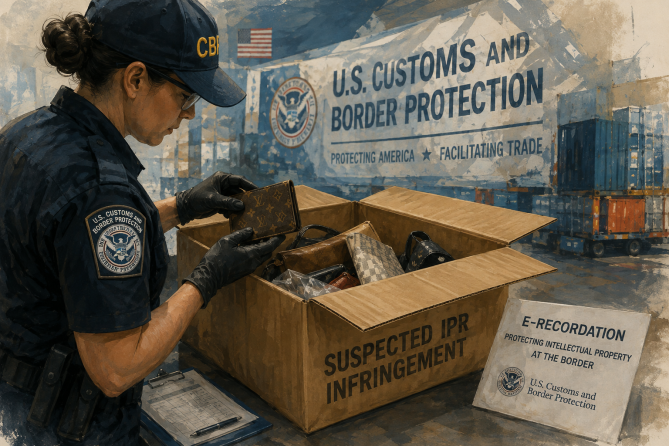
CBP’s Intellectual Property Enforcement Branch briefed eRecordation holders on August 27, 2026 on changes to the recordation application, future expanded pre-seizure disclosure authority, pending legislation, and an enforcement posture that has to consequence delivery, especially collecting penalties for IP violations. This article updates our earlier overview of CBP’s recordation program and identifies the items that should prompt rights holders to revisit existing recordations and importers to tighten sourcing controls. If your recordation was filed more than a year ago, several of these changes affect you directly. 

KEY TAKEAWAYS 

  • CBP’s FY 2025 IPR seizures reached roughly 78 million items with an MSRP near $7.4 billion, up sharply from the FY 2024 figures. 
  • The e-Recordation portal now validates against USPTO data. Supplemental Register marks, dead registrations, and classes not on the principal registration are rejected. 
  • Renewals are $80 per class and ownership changes are $80. Up to three contact emails are now accepted; one should be a monitored general inbox. 
  • CBP is piloting a Master Price List collection (national MSRP for every covered product), which will be an upload option on new applications and renewals. 
  • The Counterfeit Notification Act, which would let CBP share shipping labels, invoices, and e-commerce platform information with rights holders and their representatives , has passed both the House and Senate but must still clear final congressional action before being […]

DHS Adds 43 Companies to the UFLPA Entity List, the Largest Expansion Yet 

On July 31, 2026, the Department of Homeland Security, acting on behalf of the Forced Labor Enforcement Task Force (FLETF), announced the addition of 43 companies to the Uyghur Forced Labor Prevention Act (UFLPA) Entity List, along with technical updates to the official names of two entities already listed.  

The New List 

The revised list published as an appendix to a Federal Register notice on August 3, 2026, bringing the total to 187 entities, a roughly 30% increase, and the single largest expansion since the UFLPA took effect in 2022. The newly designated companies operate in DHS’s high-priority enforcement sectors, including aluminum, apparel, copper, cotton, and tomatoes and downstream products. Notably, a substantial share of the additions are headquartered outside the Xinjiang Uyghur Autonomous Region (XUAR), in provinces such as Shandong, Jiangsu, and Henan, which highlights that Entity List exposure is not a question of geography alone. 

CBP’s UFLPA Authority 

Under the UFLPA, U.S. Customs and Border Protection (CBP) applies the UFLPA’s rebuttable presumption under 19 U.S.C. § 1307 to goods mined, produced, or manufactured wholly or in part by any of the newly listed entities, and, critically, to downstream merchandise that incorporates their inputs. There is no de minimis threshold: a single component, raw material, or subassembly traceable to a listed company can support detention of an entire shipment.  

To secure release, an importer must either show that the UFLPA […]

What Happened This Month in International Trade (August 2026)

Another busy month in international trade news. Here’s the roundup:  

Administration:  

  • President Trump issued a proclamation imposing section 232 tariffs on certain imported unmanned aircraft systems (UAS), stating that the United States’ dependence on foreign-manufactured drones and critical drone components threatens to impair national security.  
  • The White House’s Office of Trade and Manufacturing Policy published a report discussing transshipment. The Administration estimates potential illegal transshipment in the range of $34.2 billion to $89.6 billion.  
  • President Trump issued an Executive Order creating a new national-security framework that can block certain foreign-produced electrical-grid equipment from being imported, purchased, transferred, or installed in the United States. 

Canada Tariffs: 

  • Canada announced that it is imposing tariffs of 15%, 25% or 50% on U.S. goods in a response to new 50% Section 338 tariffs on Canadian goods. The tariff changes match the 338 action dollar for dollar, and cover 6% of U.S. exports to Canada.

Customs and Border Protection (CBP)        

  • CBP filed an update with the CIT in the IEEPA refunds case. Over $132 billion in potential and certified refunds have been accepted for processing via CAPE. 272,029 CAPE declarations have been submitted, of which […]
By |2026-08-28T14:08:31-04:00August 28, 2026|news, Snapshot|0 Comments

U.S.-Canada Tariff Escalation: New Section 338 Tariffs and Canadian Retaliatory Tariffs 

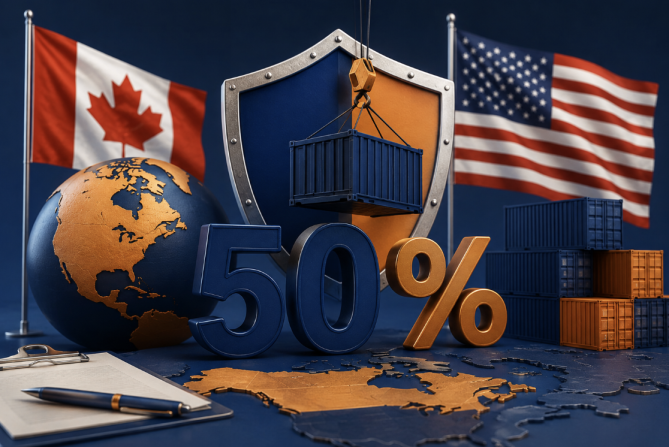
Effective August 22, 2026, the United States began imposing additional 50% tariffs on certain products of Canada under Section 338 of the Tariff Act of 1930. The duties were imposed through three Presidential Proclamations, issued on July 20, 2026, addressing alleged Canadian discrimination against U.S. products including dairy, alcoholic beverages, and motor vehicles. 

The tariffs were originally scheduled to take effect on August 19. On August 18, President Trump temporarily suspended their implementation for three days while negotiations with Canada continued, moving the effective date to 12:01 a.m. Eastern Time on August 22, 2026.  

That temporary reprieve has now expired, and U.S. Customs and Border Protection (CBP) has issued guidance explaining how importers, customs brokers, and filers should handle affected entries. 

What Is Section 338? 

Section 338 of the Tariff Act of 1930, codified at 19 U.S.C. § 1338, gives the President authority to impose additional duties of up to 50% when a foreign country discriminates against U.S. commerce or imposes certain unreasonable or unequal restrictions that place U.S. commerce at a disadvantage. 

Although Section 338 has existed for nearly a century, its use against Canada represents an unusual application of the statute.  

The 50% Tariffs Cover Far More Than Alcohol, Dairy, and Cars 

The July 20 proclamations invoked Section 338 in response to three categories of alleged Canadian discrimination: alcoholic beverages, dairy, and

By |2026-08-28T08:47:57-04:00August 28, 2026|tariffs|0 Comments

Getting Off the SDN List: A Practical Guide to OFAC’s Administrative Reconsideration Process 

Landing on the Office of Foreign Assets Control’s (OFAC) Specially Designated Nationals and Blocked Persons List (SDN List) is one of the most consequential things that can happen to a company or individual doing business in or with the United States. Assets are frozen, U.S. persons are barred from dealing with you, and banking relationships evaporate almost overnight.  

The good news is that SDN designations are not necessarily permanent. OFAC maintains a formal process – administrative reconsideration – for petitioning to have a person, entity, or piece of property removed from an OFAC-administered sanctions list. This article walks through how that process works, what to expect at each stage, and where clients most often stumble. 

Step One: Confirm You’re Using the Right Process 

Before filing anything, it’s worth pausing to confirm which removal process actually applies to your situation, because OFAC’s administrative reconsideration process is not a one-size-fits-all remedy. 

  • You are the designated party. If you, your organization, or your property appear on an OFAC-administered list because OFAC itself made the designation, the administrative reconsideration process under 31 C.F.R. § 501.807 is the correct path, and it runs through OFAC’s Reconsideration Portal. 
  • The designation was made by the State Department. Some names appear on OFAC-administered lists because the Department of State designated them (for example, under certain terrorism-related authorities). Removal in those cases goes through […]
Go to Top