tariffs

USTR Launches New Section 301 Actions: Key Developments for Importers 

The Office of the United States Trade Representative (USTR) has recently announced a series of significant Section 301 actions targeting a range of trade-related concerns, including intellectual property protection, forced labor, and alleged unfair trade practices. Collectively, these developments demonstrate the Administration’s continued willingness to utilize Section 301 as a tool to address perceived barriers to U.S. commerce and advance broader trade policy objectives. 

Vietnam

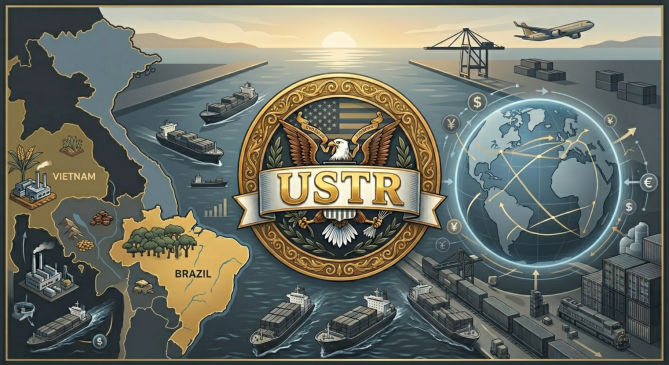
On May 29, 2026, USTR published a Federal Register Notice announcing an investigation of Vietnam under Section 301 of the Trade Act of 1974. The investigation follows identifying Vietnam as a Priority Foreign Country in the 2026 Special 301 Report, which was published on April 30, 2026. The investigation will seek to determine whether Vietnam’s persistent failure to resolve long-standing concerns about intellectual property (IP) protection and enforcement is unreasonable or discriminatory and burdens or restricts U.S. commerce

Once the investigation is complete, Ambassador Greer will determine what, if any, responsive action should be taken to address them. Comments in this proceeding are due July 2, 2026. 

Brazil

On June 2, 2026, USTR published a Federal Register Notice announcing a determination under Section 301 that certain of Brazil’s acts, policies, and practices are unreasonable and burden or restrict U.S. commerce, and are thus actionable under Section 301(b) of the Trade Act. These acts, policies, and practices include: 

    […]

Commerce Releases Applications for Onshoring Agreements to Reduce Section 232 Tariffs

On May 11, 2026, the U.S. Department of Commerce published the procedures for companies to apply for agreements with the U.S. government to reduce Section 232 tariffs on imported patented pharmaceutical products by onshoring manufacturing.

Section 232 Background 

On April 2, 2026, President Trump issued a proclamation imposing Section 232 tariffs on certain pharmaceutical products imported into the United States. Section 232 authorizes the president to adjust imports to address national security threats. In the proclamation, the President stated that the U.S.’s reliance on imports of pharmaceuticals has created fragile supply chains, threatening national security.

President Trump imposed a 100% tariff on certain patented pharmaceuticals and their associated ingredients. The tariffs will take effect for certain large companies on July 31, 2026, and for small companies on September 29, 2026.

The proclamation also included several carveouts. For example, Companies that have entered into qualifying agreements with the US government and developed plans to onshore production of patented pharmaceuticals and associated ingredients will be subject to only a 20% tariff from September 29, 2026, through April 2, 2030. 

Onshoring Agreement Application Process

On May 11, 2026, Commerce published procedures for companies to apply for Onshoring Agreements that would qualify them for the reduced 20% tariff. 

Applications must include: 

  • Organization Information: Full legal name, address, ownership structure, and beneficial ownership, including the country where the company’s headquarters is located.

Appeals Court Keeps Section 122 Tariffs in Place (For Now): What Importers Need to Know

On May 7, 2026, the U.S. Court of International Trade (“CIT”) issued a significant decision holding that the Trump Administration’s 10% global tariffs imposed under Section 122 of the Trade Act of 1974 were unlawful. Just days later, on May 12, 2026, the U.S. Court of Appeals for the Federal Circuit stepped in and temporarily stayed that ruling. 

Thus, despite a major legal victory for plaintiff-importers at the CIT, and the hope provided to non-parties seeking similar relief in their own proceedings, Section 122 tariffs remain in effect – for now – while the appeal proceeds.  

Key Takeaways from the Stay 

The stay issued by the Court of Appeals pauses the CIT’s judgment while the Appeals Court considers the government’s motion for a longer stay pending appeal. The original plaintiffs have seven days to respond to the government’s motion, and the Court of Appeals has set an expedited briefing schedule, signaling that further developments should come quickly. 

Since this decision does not adjudicate the merits of the case (i.e., agree or disagree with the CIT’s decision), importers who are not party to the original lawsuit can still plan to file their own lawsuits with the CIT because Section 122 tariffs are unlawful. Additionally, the Appeals Court’s order keeps the collection of the 122 tariffs in place.  

What This Order Means for Importers 

1. Duties Must Still Be Paid

CBP will continue to assess and collect the 10% Section […]

Can Importers Obtain Refunds After Section 122 Tariffs Were Invalidated? 

On May 7, 2026, the U.S. Court of International Trade (CIT) ruled that the Section 122 tariffs imposed by the Trump administration under the Trade Act of 1974 are invalid. Previously, tariffs imposed by the Trump administration under the International Emergency Economic Powers Act (IEEPA)—including the “reciprocal tariffs” and the “fentanyl tariffs”—had been ruled unlawful by the U.S. Supreme Court on February 20, 2026. On March 4, 2026, Judge Eaton of the CIT issued an order requiring the refund of all IEEPA tariffs paid by importers. 

So, what does the invalidation of the Section 122 tariffs mean? How does it relate to the IEEPA tariffs? Can importers who have paid Section 122 tariffs also apply for refunds?

I. The Launch and Termination of IEEPA Tariffs 

In fact, the Section 122 tariffs served as a “backup plan” for the IEEPA tariffs. To understand the relationship between the two, we must first clarify the entire process of the IEEPA tariffs from initiation to termination. 

The IEEPA tariffs were imposed by the Trump administration in 2025 under the International Emergency Economic Powers Act (IEEPA). IEEPA authorizes the President, after declaring a national emergency, to broadly regulate various economic transactions, and it is a core document of modern U.S. sanctions mechanisms. It originated from the Trading with the Enemy Act (TWEA), which was enacted after World War I to regulate transactions with hostile nations. The scope of TWEA was expanded in the 1930s, allowing the President to declare a […]

CIT Strikes Down Section 122 Tariffs: What This Means for Businesses

On the afternoon of May 7, 2026, the U.S. Court of International Trade (CIT) issued a significant decision invalidating the Trump Administration’s 10% global tariff imposed under Section 122 of the Trade Act of 1974. In State of Oregon et al. v. United States and companion cases, the court granted summary judgment for certain importer plaintiffs and permanently enjoined enforcement of the tariffs as unlawful. The Court found that only importers and not states had standing to challenge this action and limited the relief to those importer plaintiffs in Court. This relief, while precedential, does not apply at this time to anyone not in this court case. In order to benefit, it appears that entities will need to file their own case seeking similar relief. 

This decision sharply limits presidential authority to impose tariffs under Section 122 – a section of the Trade Act that the President was reliant upon after the U.S. Supreme Court struck down IEEPA tariffs in February 2026.   

The Section 122 Tariffs at Issue 

The case challenged Proclamation No. 11012, which imposed a 10% ad valorem tariff on most imported goods beginning February 24, 2026. 

The administration justified the tariffs under Section 122, which allows temporary import surcharges (up to 15%) to address “fundamental international payments problems,” including “large and serious United States balance-of-payments deficits.” 

To support the tariffs, the Proclamation relied on: 

  • A […]
By |2026-05-08T09:21:41-04:00May 7, 2026|tariffs|0 Comments
Go to Top