International Trade

Appeals Court Keeps Section 122 Tariffs in Place (For Now): What Importers Need to Know

On May 7, 2026, the U.S. Court of International Trade (“CIT”) issued a significant decision holding that the Trump Administration’s 10% global tariffs imposed under Section 122 of the Trade Act of 1974 were unlawful. Just days later, on May 12, 2026, the U.S. Court of Appeals for the Federal Circuit stepped in and temporarily stayed that ruling. 

Thus, despite a major legal victory for plaintiff-importers at the CIT, and the hope provided to non-parties seeking similar relief in their own proceedings, Section 122 tariffs remain in effect – for now – while the appeal proceeds.  

Key Takeaways from the Stay 

The stay issued by the Court of Appeals pauses the CIT’s judgment while the Appeals Court considers the government’s motion for a longer stay pending appeal. The original plaintiffs have seven days to respond to the government’s motion, and the Court of Appeals has set an expedited briefing schedule, signaling that further developments should come quickly. 

Since this decision does not adjudicate the merits of the case (i.e., agree or disagree with the CIT’s decision), importers who are not party to the original lawsuit can still plan to file their own lawsuits with the CIT because Section 122 tariffs are unlawful. Additionally, the Appeals Court’s order keeps the collection of the 122 tariffs in place.  

What This Order Means for Importers 

1. Duties Must Still Be Paid

CBP will continue to assess and collect the 10% Section […]

Can Importers Obtain Refunds After Section 122 Tariffs Were Invalidated? 

On May 7, 2026, the U.S. Court of International Trade (CIT) ruled that the Section 122 tariffs imposed by the Trump administration under the Trade Act of 1974 are invalid. Previously, tariffs imposed by the Trump administration under the International Emergency Economic Powers Act (IEEPA)—including the “reciprocal tariffs” and the “fentanyl tariffs”—had been ruled unlawful by the U.S. Supreme Court on February 20, 2026. On March 4, 2026, Judge Eaton of the CIT issued an order requiring the refund of all IEEPA tariffs paid by importers. 

So, what does the invalidation of the Section 122 tariffs mean? How does it relate to the IEEPA tariffs? Can importers who have paid Section 122 tariffs also apply for refunds?

I. The Launch and Termination of IEEPA Tariffs 

In fact, the Section 122 tariffs served as a “backup plan” for the IEEPA tariffs. To understand the relationship between the two, we must first clarify the entire process of the IEEPA tariffs from initiation to termination. 

The IEEPA tariffs were imposed by the Trump administration in 2025 under the International Emergency Economic Powers Act (IEEPA). IEEPA authorizes the President, after declaring a national emergency, to broadly regulate various economic transactions, and it is a core document of modern U.S. sanctions mechanisms. It originated from the Trading with the Enemy Act (TWEA), which was enacted after World War I to regulate transactions with hostile nations. The scope of TWEA was expanded in the 1930s, allowing the President to declare a […]

FDA Update: Increased Cosmetics Oversight Under MoCRA 

The U.S. Food and Drug Administration (FDA) recently published a Voices blog, highlighting the progress the agency has made in implementing the Modernization of Cosmetics Regulation Act of 2022 (MoCRA).

MoCRA Background

MoCRA instituted a sweeping overhaul of federal cosmetics regulation that significantly expanded the FDA’s authority over the cosmetics and personal care industry. The FDA views MoCRA as the most substantial expansion of FDA cosmetics oversight since the Federal Food, Drug, and Cosmetic Act was enacted in 1938.

MoCRA was signed into law in December 2022 and introduced a broad range of new regulatory requirements aimed at improving consumer safety, increasing transparency, and strengthening FDA enforcement capabilities. The law applies to a wide array of cosmetic products, including makeup, skincare, fragrances, shampoos, and other personal care items used daily by consumers.

Implementation Update

In its recent update, the FDA highlighted several ways the legislation is already reshaping the cosmetics industry. One of the most significant developments is the agency’s increased visibility into cosmetic manufacturing and ingredient use through mandatory facility registration and product listing requirements. The FDA reported:

  • 15,000 unique, active cosmetic product facility registrations
  • Over 1 million unique, active cosmetic product listings.
  • adverse events reported by industry increased by more than threefold

Before MoCRA, the FDA received just 5,176 cosmetic establishment registrations and 35,102 cosmetic product listings through the Voluntary Cosmetic Registration Program. This […]

New AD/CVD Case Filed Against Stationary and Portable Air Compressors from China, Malaysia, and Vietnam 

A new antidumping and countervailing duty action has been filed against stationary and portable air compressors from China, Malaysia, and Vietnam. The allegation is that imports from China, Malaysia, and Vietnam are unfairly subsidized and are being dumped.  

Full list of importers here.  

Full list of exporters here.

Background on AD/CVD Investigations 

 Antidumping duty (“AD”) and countervailing duty (“CVD”) investigations are brought jointly by the U.S. International Trade Commission (“USITC”) and the U.S. Department of Commerce (“Commerce”). AD investigations are triggered when a domestic industry alleges that it has been injured by competing imports of particular goods from specific countries being sold at less than a fair value. Meanwhile, CVD investigations are triggered when a domestic industry alleges that it has been injured by competing imports that are being unfairly subsidized by their governments. The domestic industry initiating the investigation is known as the petitioner, while the foreign industry participating in the investigation is known as the respondent.

Scope of the Investigation  

The merchandise covered by these investigations is stationary and portable air compressors, electric, gas, and battery-powered.  

The products subject to the investigation are currently classified in the Harmonized Tariff Schedule of the United States (HTSUS) under the following subheadings: 8414.80.1615, 8414.80.1625, 8414.80.1635, and 8414.80.1685.  

Full scope here.

Next Steps 

The Commerce Department will determine whether to initiate the investigations within […]

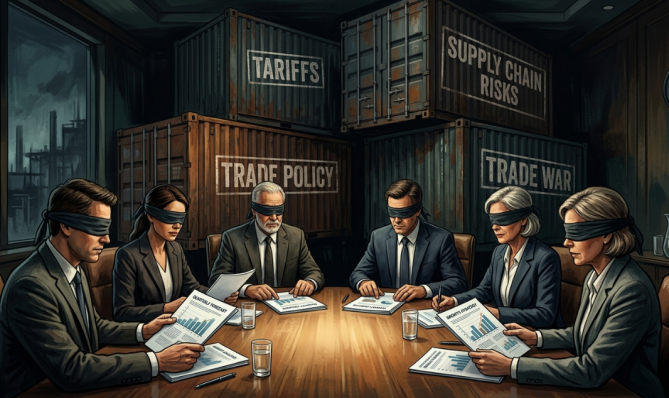
Tariff and Macroeconomic Risk Disclosures:

Lessons from Recent Shareholder Litigation Against Dow and Tronox

Authors:  

Jennifer Diaz, President, Diaz Trade Law
Amber Pirson, Attorney, Diaz Trade Law 

Recent securities class actions against Dow Inc. and Tronox Holdings plc underscore the growing litigation risk associated with tariff‑related and broader economic disclosures in periodic reports, earnings calls, and investor communications. These cases highlight how shareholder plaintiffs are scrutinizing statements that characterize tariffs and related headwinds as manageable, temporary, or hypothetical when subsequent developments suggest a more pronounced or foreseeable impact. 

As public companies continue to navigate volatile trade policy, supply chain disruption, and demand uncertainty, these lawsuits provide concrete guidance on how the SEC’s disclosure framework—particularly risk factors and Management’s Discussion and Analysis (MD&A) “known trends” disclosures—may be applied in hindsight by regulators and private litigants. 

Regulatory Framework: Risk Factors and Known Trends 

SEC rules make clear that companies must disclose certain risks to investors. For example, Item 105 of Regulation S‑K requires companies to disclose material risks that make an investment speculative or risky, while Item 303 requires MD&A discussion of known trends, events, or uncertainties reasonably likely to have a material impact on financial condition or operating results. In this context, tariffs – particularly where they affect costs, pricing, demand, or dividends – have increasingly been viewed as classic “known trends,” rather than contingent or […]

Go to Top