U.S. Customs and Border Protection (CBP)

2026 CBP Trade and Cargo Security Summit: Key Takeaways for Importers 

U.S. Customs and Border Protection (CBP) brought together government officials and members of the trade community in Dallas from September 8–10, 2026, for its annual Trade and Cargo Security Summit (TCSS). This year’s theme “Knowing Your Supply Chain to Remain Compliant and Mitigate Risk” was reflected throughout three days of discussions on enforcement, supply chain visibility, artificial intelligence, forced labor, transshipment, CTPAT, cybersecurity, and the future of customs compliance.  

Here are some of the most important takeaways for importers.

  1. CBP Is Entering a New Era of Customs Enforcement

A major focus of the Summit was the Administration’s June 3, 2026 “Strengthening Customs Enforcement” Executive Order and the regulatory changes expected to follow. 

The Executive Order calls for, among other things, heightened requirements for Importers of Record (IORs), expanded data and identification requirements, and increased vetting of IORs and other parties throughout the import process. CBP officials emphasized that implementation will be an agency-wide effort and that additional regulatory packages are expected.  

The shift is already visible in the government’s broader enforcement posture. Discussions at the Summit emphasized customs fraud, shell companies, identity theft, false importer information, double invoicing, and other schemes CBP is encountering in the trade environment. CBP also stressed that its focus is not on ordinary clerical mistakes, but on identifying and escalating consequences for parties intentionally exploiting the system.  

  1. Supply Chain Visibility Is Becoming a National Security Issue

Perhaps no […]

China Blacklists Six U.S. Supply Chain Tracing Providers: What UFLPA Importers Need to Know

On August 5, 2026, China’s Ministry of Commerce placed six U.S. supply chain due diligence entities on its countermeasure list and prohibited organizations and individuals in China from transacting or cooperating with them. The six include the DNA tagging, isotopic testing, supply chain mapping, and labor audit providers that many importers rely on to document origin when U.S. Customs and Border Protection (CBP) detains goods under the Uyghur Forced Labor Prevention Act (UFLPA). Importers in cotton, apparel, electronics, minerals, and other UFLPA high-priority sectors should treat this as a direct hit on their evidence chain and act now. 

Key Takeaways 

  • On August 5, 2026, China’s Ministry of Commerce (MOFCOM) issued Order No. 2 of 2026 placing six U.S. entities on its countermeasure list under the Anti-Foreign Sanctions Law: Applied DNA Sciences, Inc.; Stratum Reservoir, LLC; Altana Technologies, Inc.; Responsible Business Alliance; Verite Group, Inc.; and Human Rights in China. 
  • The countermeasure prohibits organizations and individuals within China from engaging in relevant transactions, cooperation, and other activities with the six entities, effective August 5, 2026. The order imposes no asset freeze and no entry ban. 
  • MOFCOM’s spokesperson tied the package to the July 31, 2026 addition of 43 entities to the UFLPA Entity List, published in the Federal Register on August 3, 2026, which brought the list to 187 entities. 
  • The listed entities include providers of DNA tagging, […]

Wood Packaging Material Violations: What to Do When CBP Issues an EAN 

This article explains what an importer should do in the first 24 hours after CBP issues an Emergency Action Notification (EAN) for non-compliant wood packaging material (WPM), how CBP calculates and mitigates the penalties that follow, and how the new APHIS-approved shredder-hammermill treatment can save the underlying cargo. It matters because a WPM penalty is assessed at the full domestic value of the merchandise, requires no pre-penalty notice, and can be issued even when the importer fully complies with the EAN. The decisions made before the cargo leaves the port determine how much of that exposure survives. 

KEY TAKEAWAYS 

  • An Emergency Action Notification (EAN) for non-compliant wood packaging material is not the end of the matter. It is the start of a penalty file. Call counsel the day it arrives, not the day the penalty notice arrives. 
  • CBP penalties for WPM violations are assessed at the domestic value of the merchandise under 19 U.S.C. § 1595a(b), with no pre-penalty notice required. A single violation is enough. The old five-violation threshold was eliminated in 2017. 
  • Mitigation is real but shrinks fast: 1 to 10 percent of the penalty on a first violation, 10 to 25 percent on a second, and a 25 percent floor on the third. Documented immediate remediation and cooperation are what move you toward the low end. 
  • Shredder-hammermilling is now an APHIS-approved treatment for non-compliant […]

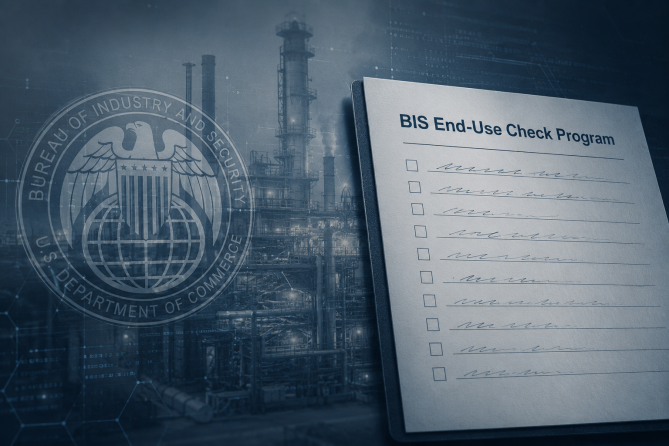
BIS End-Use Checks: What Happens When an Export Control Officer Calls Your Customer 

BIS has published a plain-language FAQ on its End-Use Check program, the on-site visits its Export Control Officers conduct at foreign consignees and end users of U.S.-origin items. This article explains what those visits are, what your foreign customer will be asked to produce, the statutory and regulatory authority behind the request, and the consequences when a check cannot be completed. It matters because the penalty for a failed check falls on the exporter’s ability to ship, not only on the foreign party being visited. 

Key Takeaways 

  • An End-Use Check (EUC) is BIS verifying, on site and overseas, that your foreign customer is who it says it is and used your items the way the license or the EAR required. 
  • A failed or incomplete check does not need a finding of wrongdoing to hurt you. The customer can land on the Unverified List, license exceptions disappear, and every shipment then requires a UVL statement. 
  • Since October 2022, a check that stays incomplete for 60 days after Unverified List placement, because a host government blocks it, triggers Entity List proceedings. 
  • The exporter’s exposure is set before the visit ever happens: by the accuracy of the license application, the quality of the paper trail, and whether the foreign party was told what to expect. 
  • Diaz Trade Law prepares exporters […]

CBP Wants Your Foreign Export Documents: What the Supply Chain Visibility ANPRM Means for Importers

On September 2, 2026, U.S. Customs and Border Protection published an advance notice of proposed rulemaking that would fundamentally change what importers must know, keep, and disclose about the parties behind every shipment entering the United States. The notice implements Section 3 of Executive Order 14411 and covers foreign export documentation, replacement of the manufacturer identification code, foreign tax and global business identifiers, supply chain tracing technology, and expanded CTPAT requirements. Comments are due December 1, 2026, and the questions CBP is asking tell importers exactly where enforcement is headed. 

KEY TAKEAWAYS 

  • CBP published an advance notice of proposed rulemaking on September 2, 2026 (Docket No. USCBP-2026-1058) that would give the agency visibility into every party in an import supply chain, from the foreign factory to the final delivery address. 
  • The headline proposal: importers of record may be required to obtain, retain, and submit the export declaration, invoice, packing list, and other documents their foreign supplier filed with its own customs authority. CBP says the purpose is to catch dual invoicing and undervaluation. 
Go to Top