U.S. Customs and Border Protection (CBP)

De Minimis No More: What it Means for Importers and Consumers

President Trump’s Executive Order suspending duty-free de minimis treatment of shipments entering the U.S. took effect last week. The de minimis exemption has been used by retailers around the world catering to the American shopper, and the end of the policy is causing a ripple effect around the globe.

What is De Minimis?

De minimis is a Latin term that means “of the smallest things,” “trifling,” “insignificant.” In the U.S., the de minimis rule dates back to the Tariff Act of 1930. Upon passage of the act, individuals and businesses were permitted to import shipments under $200 without paying duties and taxes. 

The intent behind the exemption was to allow CBP to focus on higher-risk and higher-revenue imports and to encourage small-scale trade. In 2016, the U.S. raised the de minimis threshold to $800 with the passage of the Trade Facilitation and Trade Enforcement Act. 

After the 2016 change, de minimis shipments surged, from 139 million in FY 2015 to 1.36 billion in FY 2024. International retailers took advantage of the new threshold, and many U.S. policymakers began referring to de minimis as a “loophole.” 

Citing safety and fairness concerns, there were dozens of unsuccessful efforts in the U.S. Congress to end de minimis. Finally, the Big Beautiful Bill of 2025

ICYMI: FDA Launches Nationalized Entry Review Program (NER)

FDA recently implemented the Nationalized Entry Review Program (NER), which centralizes how the agency reviews imports nationwide. The program is effective as of August 4, 2025. Key changes include: 

  • Coordinated National Response: Rather than each port conducting manual reviews of certain entries on its own, specialized teams now coordinate their efforts across the country to more quickly identify and stop dangerous products.

  • Harmonized Real-Time Alert System: If the FDA detects a high-risk product at one port, such as contaminated infant formula or counterfeit drugs, alerts are immediately shared across all ports so they can watch for the same threats.

  • Improved Efficiency: Built on a successful 2022 pilot, the NER program has sped up processing by 70% and increased detection of high-risk products by 36%.

  • Expanded Reviewer Capacity: The program allows for more FDA reviewer availability and collaboration across the national network. 

The FDA’s current evaluative standards, regulatory requirements, and admissibility thresholds remain the same. 

The FDA has also published a communications guide that includes general contact protocols, hot shipments handling, email formatting requirements, and FAQs.

Diaz Trade Law provides assistance with FDA pre-compliance as well as assistance in successfully navigating FDA enforcement actions. For assistance with NER requirements or other FDA matters, contact us […]

DHS Adds Additional UFLPA High-Priority Sectors; Releases UFLPA 2025 Strategy Update

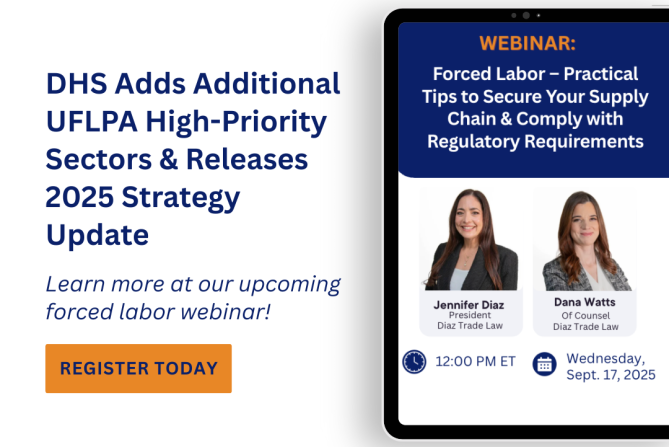
Learn more about this update and all things UFLPA at our upcoming forced labor webinar on Sept. 17, 2025. Register here.

On August 19, 2024, the U.S. Department of Homeland Security (DHS) announced that it would be adding steel, copper, lithium, caustic soda, and red dates to the list of high-priority sectors for enforcement under the Uyghur Forced Labor Prevention Act (UFLPA). DHS also announced the release of an update to the UFLPA enforcement strategy.

Addition of High-Priority Sectors

Under the UFLPA, DHS is tasked with identifying high-priority sectors for enforcement. A high-priority sector designation indicates that entities in the sector have a higher risk of forced labor or state labor transfer of Uyghurs and other ethnic minorities from Xinjiang. 

In making the announcement of additional sectors, DHS cited each new addition’s connections to forced labor risks. For example, DHS stated that steel and copper have both been government-backed investment focal points in Xinjiang. Similarly, lithium is a government-identified key sector for investment and development in Xinjiang.

UFLPA Enforcement Strategy Update

DHS serves as the chair of the Forced Labor Enforcement Task Force (FLETF). Each year, the task force updates the UFLPA’s Strategy to Prevent the Importation of Goods Mined, Produced, or Manufactured with Forced Labor in the People’s Republic of China (UFLPA Strategy). The task force is statutorily required to provide annual updates […]

Census Bureau Releases Final Rule Clarifying Filing Requirements for In-Transit Shipments 

On August 14, 2025, The Census Bureau issued a final rule to clarify its regulations governing in-transit shipments from foreign countries through the United States that are subsequently exported to a foreign destination. The rule takes effect September 15, 2025. 

Background

The Census Bureau is responsible for collecting, compiling, and publishing import and export trade statistics for the United States. As part of this responsibility, the Census collects Electronic Export Information (EEI) in concert with the export control and enforcement functions of U.S. Customs and Border Protection (CBP) of the Department of Homeland Security (DHS), the Bureau of Industry and Security (BIS), and the Directorate of Defense Trade Controls (DDTC).

Public Law 107-228 directed the Census to publish regulations requiring exporters to file Shippers’ Export Declarations. As a result, the bureau experienced an increase in the number of inquiries regarding in-transit movements. Accordingly, in October of 2024 the Census solicited comments on a proposed rule to clarify its regulations governing in-transit shipments. The bureau received 11 letters and emails commenting on the proposed rule.

Key Changes

In addition to making definitional, grammatical and style changes, the rule: (i) clarifies who is the USPPI; (ii) makes changes to mandatory filing requirements; (iii) makes changes to voluntary self-disclosures.  

Who is the USPPI

The U.S. Principal Party in Interest (USPPI) is the person or legal entity in the United States that receives the primary benefit, […]

Bond Insufficiency Notices Are at an All Time High – Don’t Let This Happen to You!

With rising tariffs, U.S. Customs and Border Protection (CBP) is busy sending importers bond insufficiency notices advising them that their existing customs bond no longer covers their obligations. 

What is a Customs Bond

A customs bond, sometimes called a surety or import bond, is a financial guarantee that ensures importers meet CBP regulations and pay all applicable duties, taxes, fines, and penalties related to importing goods into the United States.

The most common type of bond is an import bond, which is required on all commercial shipments of goods valued over $2,500. An import bond is also required for shipments that are subject to other U.S. government agency requirements.

A single transaction bond can be used for a single entry. However, most importers utilize continuous bonds, which self-renew yearly and cover all customs transactions through any port of entry.

Insufficiency Notices on the Rise

CBP reviews the sufficiency of all active continuous import bonds on a monthly basis. If an importer’s bond has exceeded its capacity, CBP will issue a demand for a larger bond in the form of an insufficiency notice. The recent increase in tariffs means increased bond amounts, and many importers are struggling to properly calculate their bonds to keep them current. The number of bond insufficiency notices issued has quadrupled since 2017 and has accelerated recently with the volatile tariff environment. 50% of insufficient bonds are for bonds under $100k.

Chart courtesy of Colleen Clarke, SVP at Roanoke, GTE Conference 2025

Bond Calculations

CBP provides […]

Go to Top