
Forced Labor Enforcement Just Crossed a Border: What CBP’s Serbia Copper WRO Means for Your Supply Chain

Key Takeaways 

  • CBP continues to chase the company, not just the country. Zijin’s parent was already on the UFLPA Entity List for forced labor in China; this Withhold Release Order (WRO) hits its Serbian copper operation on a separate evidentiary basis. Moving production to a “friendly” country does not move you out of CBP’s reach. 
  • Copper just joined the enforcement map. Forced-labor detentions are no longer concentrated in apparel, solar, and cotton. If you import copper—or anything containing it—your supply chain is now in scope, and most copper-reliant importers have done zero forced-labor due diligence. 
  • The burden is on you, and it lands the moment your shipment is detained. Under a WRO, there is no notice and no grace period. You either prove your goods are clean by detailed documentary evidence, or you export or destroy them. 

On June 16, 2026, U.S. Customs and Border Protection (CBP) issued a Withhold Release Order against copper and copper products manufactured in Serbia by Serbia Zijin Copper D.O.O.—the fourth WRO of Fiscal Year 2026 and the second targeting a Serbian operation in roughly six months. Effective immediately, CBP personnel at every U.S. port of entry will detain shipments of copper and copper products from this company. 

If you read that as another distant enforcement headline, you are missing the part that should concern you. This […]
CBP Just Rewrote the Forced Labor Rulebook: What the New Operational Guidance Means for Importers

Short summary: On June 9, 2026, CBP issued new guidance supplementing its 2022 UFLPA guidance and other resources with a single document covering every forced-labor authority it enforces. The new guidance outlines CBP’s detention and exclusion processes and gives practical guidance on how to respond.


On June 9, 2026, U.S. Customs and Border Protection (CBP) published its new Forced Labor Enforcement Operational Guidance for Importers (Publication No. 5560-0526). It is not a refresh. It updates the June 13, 2022, UFLPA Operational Guidance for Importers and, for the first time, consolidates all forced-labor enforcement authorities CBP wields into a single 89-page reference. 

That consolidation is the story. Until now, importers had to stitch together separate sources to understand how the Uyghur Forced Labor Prevention Act (UFLPA), Withhold Release Orders and Findings under 19 U.S.C. § 1307, and the Countering America’s Adversaries Through Sanctions Act (CAATSA) actually differ in practice. CBP has now mapped all of them — including the exact timelines, the review paths, and the documentation bar — in one place. The practical effect: ignorance of the process is no longer a defensible position. 

The one-line summary every importer needs 

CBP detains or excludes goods it suspects were made, wholly or in part, with forced labor — and the burden is on you to prove they weren’t, on a clock that can […]

USTR Launches New Section 301 Actions: Key Developments for Importers 

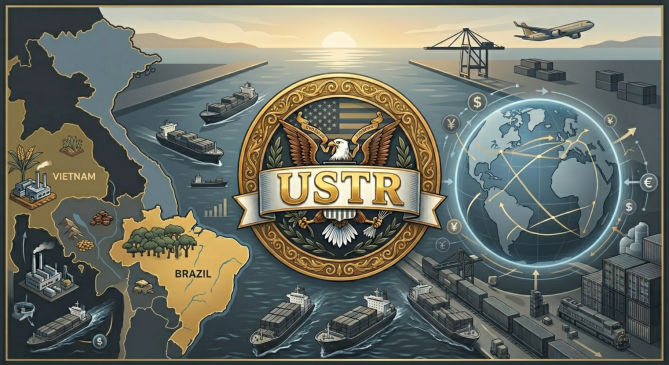
The Office of the United States Trade Representative (USTR) has recently announced a series of significant Section 301 actions targeting a range of trade-related concerns, including intellectual property protection, forced labor, and alleged unfair trade practices. Collectively, these developments demonstrate the Administration’s continued willingness to utilize Section 301 as a tool to address perceived barriers to U.S. commerce and advance broader trade policy objectives. 

Vietnam

On May 29, 2026, USTR published a Federal Register Notice announcing an investigation of Vietnam under Section 301 of the Trade Act of 1974. The investigation follows identifying Vietnam as a Priority Foreign Country in the 2026 Special 301 Report, which was published on April 30, 2026. The investigation will seek to determine whether Vietnam’s persistent failure to resolve long-standing concerns about intellectual property (IP) protection and enforcement is unreasonable or discriminatory and burdens or restricts U.S. commerce

Once the investigation is complete, Ambassador Greer will determine what, if any, responsive action should be taken to address them. Comments in this proceeding are due July 2, 2026. 

Brazil

On June 2, 2026, USTR published a Federal Register Notice announcing a determination under Section 301 that certain of Brazil’s acts, policies, and practices are unreasonable and burden or restrict U.S. commerce, and are thus actionable under Section 301(b) of the Trade Act. These acts, policies, and practices include: 

    […]

U.S. Department of Labor Introduces New Tools to Support Supply Chain Integrity and Address Unfair Foreign Labor Practices

On April 8, 2026, the U.S. Department of Labor (DOL) announced the launch of several tools to empower U.S. companies to strengthen their supply chains and defend against unfair competition stemming from overseas labor abuses.

Self-Assessment Tools

DOL launched four voluntary self-assessment tools that provide practical, user-friendly guidance to help companies map supply-chain risks and evaluate labor practices. The tools can also guide companies in taking steps to ensure alignment with U.S. forced labor laws and strengthen supply chains that support American workers and American industry.

The new tools are: 

  • LaborShield: A mobile app that features information on egregious labor violations in over 145 countries (formerly the Sweat and Toil app).
  • ImportWatch: A resource that brings together the department’s labor abuse research with U.S. import data from the U.S. Census Bureau to produce a red-flag list of all high-risk goods for U.S. importers.
  • SourcingStrong: A tool to help U.S. businesses build strong labor due diligence systems to identify and manage risk in their supply chains.
  • Supply Chain Traceability Portal: The portal provides visibility across supply chains and beyond the first tier to expose where exploitative labor hides.

Announcement Insights 

Diaz Trade Law was in attendance at the launch event in Washington, D.C. – hosted by the DOL and […]

Section 301 Investigation into Forced Labor Practices — US Allies and FTA Partners Under Scrutiny

On March 12, 2026, the United States Trade Representative (USTR) published its Initiation of Section 301 Investigations into the practices of various economies, including that of US allies and long-standing trade partners, for their alleged failure to prohibit the importation of goods produced with forced labor.  

What Can the USTR Do? 

Section 301, formally known as Title III of the Trade Act of 1974 or “Relief from Unfair Trade Practices,” authorizes the USTR to investigate acts, policies, or practices that it considers unreasonable, discriminatory, or burdensome to US commerce. The USTR goes on to say that practices which permit forced or compulsory labor meet the criteria of unreasonable, unfair, and inequitable. If the USTR concludes that an act is “unjustifiable” and “burdens or restricts” US commerce, action is mandatory. On the other hand, if the USTR determines that such act is only “unreasonable or discriminatory” and “burdens or restricts” US commerce, action is discretionary. In either case, when the USTR aims to remedy a foreign trade practice, the agency can (1) impose tariffs or other import restrictions, (2) withdraw or suspend trade agreement concessions, or (3) enter into a binding agreement with the foreign government to either cease the conduct in question or compensate the US. Additionally, the statute requires that when USTR’s action is mandatory, the agency’s action should “affect goods or services of the foreign country in an amount that is equivalent in value to the burden or restriction […]

By |2026-03-16T08:20:41-04:00March 16, 2026|Forced Labor|0 Comments
Go to Top