ICYMI: FDA Launches Nationalized Entry Review Program (NER)

FDA recently implemented the Nationalized Entry Review Program (NER), which centralizes how the agency reviews imports nationwide. The program is effective as of August 4, 2025. Key changes include: 

  • Coordinated National Response: Rather than each port conducting manual reviews of certain entries on its own, specialized teams now coordinate their efforts across the country to more quickly identify and stop dangerous products.

  • Harmonized Real-Time Alert System: If the FDA detects a high-risk product at one port, such as contaminated infant formula or counterfeit drugs, alerts are immediately shared across all ports so they can watch for the same threats.

  • Improved Efficiency: Built on a successful 2022 pilot, the NER program has sped up processing by 70% and increased detection of high-risk products by 36%.

  • Expanded Reviewer Capacity: The program allows for more FDA reviewer availability and collaboration across the national network. 

The FDA’s current evaluative standards, regulatory requirements, and admissibility thresholds remain the same. 

The FDA has also published a communications guide that includes general contact protocols, hot shipments handling, email formatting requirements, and FAQs.

Diaz Trade Law provides assistance with FDA pre-compliance as well as assistance in successfully navigating FDA enforcement actions. For assistance with NER requirements or other FDA matters, contact us […]
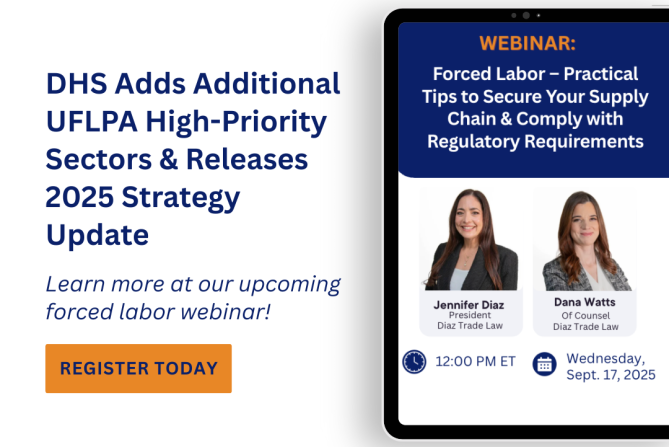
DHS Adds Additional UFLPA High-Priority Sectors; Releases UFLPA 2025 Strategy Update

Learn more about this update and all things UFLPA at our upcoming forced labor webinar on Sept. 17, 2025. Register here.

On August 19, 2024, the U.S. Department of Homeland Security (DHS) announced that it would be adding steel, copper, lithium, caustic soda, and red dates to the list of high-priority sectors for enforcement under the Uyghur Forced Labor Prevention Act (UFLPA). DHS also announced the release of an update to the UFLPA enforcement strategy.

Addition of High-Priority Sectors

Under the UFLPA, DHS is tasked with identifying high-priority sectors for enforcement. A high-priority sector designation indicates that entities in the sector have a higher risk of forced labor or state labor transfer of Uyghurs and other ethnic minorities from Xinjiang. 

In making the announcement of additional sectors, DHS cited each new addition’s connections to forced labor risks. For example, DHS stated that steel and copper have both been government-backed investment focal points in Xinjiang. Similarly, lithium is a government-identified key sector for investment and development in Xinjiang.

UFLPA Enforcement Strategy Update

DHS serves as the chair of the Forced Labor Enforcement Task Force (FLETF). Each year, the task force updates the UFLPA’s Strategy to Prevent the Importation of Goods Mined, Produced, or Manufactured with Forced Labor in the People’s Republic of China (UFLPA Strategy). The task force is statutorily required to provide annual updates […]

Census Bureau Releases Final Rule Clarifying Filing Requirements for In-Transit Shipments 

On August 14, 2025, The Census Bureau issued a final rule to clarify its regulations governing in-transit shipments from foreign countries through the United States that are subsequently exported to a foreign destination. The rule takes effect September 15, 2025. 

Background

The Census Bureau is responsible for collecting, compiling, and publishing import and export trade statistics for the United States. As part of this responsibility, the Census collects Electronic Export Information (EEI) in concert with the export control and enforcement functions of U.S. Customs and Border Protection (CBP) of the Department of Homeland Security (DHS), the Bureau of Industry and Security (BIS), and the Directorate of Defense Trade Controls (DDTC).

Public Law 107-228 directed the Census to publish regulations requiring exporters to file Shippers’ Export Declarations. As a result, the bureau experienced an increase in the number of inquiries regarding in-transit movements. Accordingly, in October of 2024 the Census solicited comments on a proposed rule to clarify its regulations governing in-transit shipments. The bureau received 11 letters and emails commenting on the proposed rule.

Key Changes

In addition to making definitional, grammatical and style changes, the rule: (i) clarifies who is the USPPI; (ii) makes changes to mandatory filing requirements; (iii) makes changes to voluntary self-disclosures.  

Who is the USPPI

The U.S. Principal Party in Interest (USPPI) is the person or legal entity in the United States that receives the primary benefit, […]

ICYMI: USDA Plan Calls for Stronger Enforcement of Agricultural Imports

On July 8, 2025, the U.S. Department of Agriculture (USDA), along with the Department of Homeland Security (DHS), the Department of Justice (DoJ), and the Department of Defense (DoD), released a National Farm Security Action Plan to elevate American agriculture as a key element of the country’s national security. 

Plan Details

The action plan will enable USDA to work closely with governors, state legislators, and federal partners to further integrate agriculture into the broader national security efforts over the coming months and years.

The USDA and its government partners will take “aggressive action” across seven critical areas:

  1. Secure and Protect American Farmland – Address U.S. foreign farmland ownership from adversaries head-on. Total transparency. Tougher penalties.
  2. Enhance Agricultural Supply Chain Resilience – Refocus domestic investment into key manufacturing sectors and identify non-adversarial partners to work with when domestic production is not available. Plan for contingencies.
  3. Protect U.S. Nutrition Safety Net from Fraud and Foreign Exploitation – Billions have been stolen by foreign crime rings. That ends now.
  4. Defend Agricultural Research and Innovation – No more sweetheart deals or secret pacts with hostile nations. American ideas stay in America.
  5. Put America First in Every USDA Program – From farm loans to food safety, every program will reflect the America […]

Jennifer Diaz Featured in the Wall Street Journal

We are pleased to announce that DTL President Jennifer Diaz was recently featured in the Wall Street Journal!  

Reporter Corinne Ramey walks through the recent uptick in efforts to evade rising tariffs and how the federal government is responding. She quoted Jennifer on DTL’s approach to advising clients on enforcement. 

Below are a few snippets from the piece. Read the full article on the WSJ.com here. 

“First came President Trump’s announcements of sweeping tariffs. Next up, lawyers say, is the cheating. 

Trade lawyers say that as tariffs skyrocket, so too do the incentives not to pay them. Clients are inundating them with questions about the line between lawful loopholes and fraud. 

At the same time, the Justice Department’s shifting white-collar priorities to pursue tariff and customs-related cases more aggressively have helped create a perfect storm for more trade enforcement. And lawyers say they have seen a sharp increase in calls from whistleblowers looking to file their own cases about alleged wrongdoing…” 

“Jennifer Diaz, a Florida trade lawyer, said her firm was ramping up its criminal expertise to prepare for a new wave of enforcement. The firm now advises clients on regulatory matters and navigating customs rules.  

‘To have this topic being front page news on a daily basis is a trade lawyer’s dream,’ Diaz said.” 

Diaz Trade Law is […]

Go to Top