Jen

About Jennifer Diaz

This author has not yet filled in any details.
So far Jennifer Diaz has created 1131 blog entries.

White House Releases National Security Science & Technology Strategy: What It Signals for CFIUS, Outbound Investment, and Export Controls 

As mandated by Section 10612 of the CHIPS and Science Act, the White House Office of Science and Technology Policy (OSTP) issued the National Security Science and Technology Strategy (NSSTS), which implements the S&T priorities of the 2025 National Security Strategy. While framed as a technology strategy, the NSSTS previews concrete near-term action on CFIUS, outbound investment, export controls, and federal research security — direct touchpoints for clients in cross-border investment, controlled technology, and federally funded R&D. 

Key Takeaways 

  • CFIUS’ scope is set to expand. The Administration will seek authority, in consultation with Congress, to monitor high-risk “greenfield” investments and to expand CFIUS’s critical-technology jurisdiction, while continuing to calibrate scrutiny to an investor’s “verifiable distance” from adversary-linked actors under the America First Investment Policy’s allied fast-track approach. 
  • Outbound investment restrictions will broaden. Treasury will refine and likely expand the Outbound Investment Security Program (Comprehensive Outbound Investment National Security Act of 2025) beyond its current scope – AI, quantum, semiconductors, supercomputers, and hypersonics – to reach additional sectors implicated by China’s military-civil fusion strategy. Although the current NSSTS did not reference other countries by name, the strategy will likely be implemented in a way that circumvents particular investments in Hong Kong, Macau, Cuba, Iran, Russia, Iran, and North Korea – in line with President Trump’s “America-first investment policy,” published in February 2025. 
  • Export controls: deregulation and new restrictions in parallel. BIS is streamlining select controls (e.g., a […]

Wood Packaging Material Violations: What to Do When CBP Issues an EAN 

This article explains what an importer should do in the first 24 hours after CBP issues an Emergency Action Notification (EAN) for non-compliant wood packaging material (WPM), how CBP calculates and mitigates the penalties that follow, and how the new APHIS-approved shredder-hammermill treatment can save the underlying cargo. It matters because a WPM penalty is assessed at the full domestic value of the merchandise, requires no pre-penalty notice, and can be issued even when the importer fully complies with the EAN. The decisions made before the cargo leaves the port determine how much of that exposure survives. 

KEY TAKEAWAYS 

  • An Emergency Action Notification (EAN) for non-compliant wood packaging material is not the end of the matter. It is the start of a penalty file. Call counsel the day it arrives, not the day the penalty notice arrives. 
  • CBP penalties for WPM violations are assessed at the domestic value of the merchandise under 19 U.S.C. § 1595a(b), with no pre-penalty notice required. A single violation is enough. The old five-violation threshold was eliminated in 2017. 
  • Mitigation is real but shrinks fast: 1 to 10 percent of the penalty on a first violation, 10 to 25 percent on a second, and a 25 percent floor on the third. Documented immediate remediation and cooperation are what move you toward the low end. 
  • Shredder-hammermilling is now an APHIS-approved treatment for non-compliant […]

BIS End-Use Checks: What Happens When an Export Control Officer Calls Your Customer 

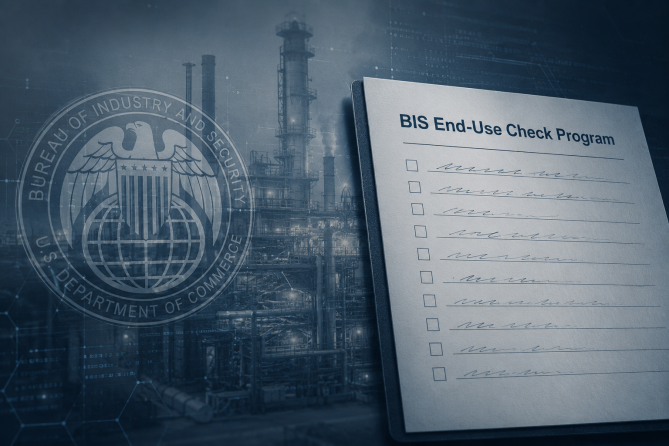
BIS has published a plain-language FAQ on its End-Use Check program, the on-site visits its Export Control Officers conduct at foreign consignees and end users of U.S.-origin items. This article explains what those visits are, what your foreign customer will be asked to produce, the statutory and regulatory authority behind the request, and the consequences when a check cannot be completed. It matters because the penalty for a failed check falls on the exporter’s ability to ship, not only on the foreign party being visited. 

Key Takeaways 

  • An End-Use Check (EUC) is BIS verifying, on site and overseas, that your foreign customer is who it says it is and used your items the way the license or the EAR required. 
  • A failed or incomplete check does not need a finding of wrongdoing to hurt you. The customer can land on the Unverified List, license exceptions disappear, and every shipment then requires a UVL statement. 
  • Since October 2022, a check that stays incomplete for 60 days after Unverified List placement, because a host government blocks it, triggers Entity List proceedings. 
  • The exporter’s exposure is set before the visit ever happens: by the accuracy of the license application, the quality of the paper trail, and whether the foreign party was told what to expect. 
  • Diaz Trade Law prepares exporters […]

CBP Wants Your Foreign Export Documents: What the Supply Chain Visibility ANPRM Means for Importers

On September 2, 2026, U.S. Customs and Border Protection published an advance notice of proposed rulemaking that would fundamentally change what importers must know, keep, and disclose about the parties behind every shipment entering the United States. The notice implements Section 3 of Executive Order 14411 and covers foreign export documentation, replacement of the manufacturer identification code, foreign tax and global business identifiers, supply chain tracing technology, and expanded CTPAT requirements. Comments are due December 1, 2026, and the questions CBP is asking tell importers exactly where enforcement is headed. 

KEY TAKEAWAYS 

  • CBP published an advance notice of proposed rulemaking on September 2, 2026 (Docket No. USCBP-2026-1058) that would give the agency visibility into every party in an import supply chain, from the foreign factory to the final delivery address. 
  • The headline proposal: importers of record may be required to obtain, retain, and submit the export declaration, invoice, packing list, and other documents their foreign supplier filed with its own customs authority. CBP says the purpose is to catch dual invoicing and undervaluation. 

CBP eRecordation Program Update: What Rights Holders and Importers Should Watch After CBP’s August 2026 Briefing 

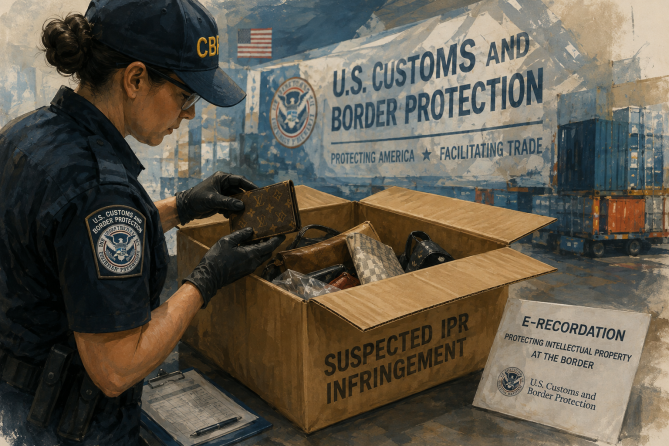
CBP’s Intellectual Property Enforcement Branch briefed eRecordation holders on August 27, 2026 on changes to the recordation application, future expanded pre-seizure disclosure authority, pending legislation, and an enforcement posture that has to consequence delivery, especially collecting penalties for IP violations. This article updates our earlier overview of CBP’s recordation program and identifies the items that should prompt rights holders to revisit existing recordations and importers to tighten sourcing controls. If your recordation was filed more than a year ago, several of these changes affect you directly. 

KEY TAKEAWAYS 

  • CBP’s FY 2025 IPR seizures reached roughly 78 million items with an MSRP near $7.4 billion, up sharply from the FY 2024 figures. 
  • The e-Recordation portal now validates against USPTO data. Supplemental Register marks, dead registrations, and classes not on the principal registration are rejected. 
  • Renewals are $80 per class and ownership changes are $80. Up to three contact emails are now accepted; one should be a monitored general inbox. 
  • CBP is piloting a Master Price List collection (national MSRP for every covered product), which will be an upload option on new applications and renewals. 
  • The Counterfeit Notification Act, which would let CBP share shipping labels, invoices, and e-commerce platform information with rights holders and their representatives , has passed both the House and Senate but must still clear final congressional action before being […]
Go to Top