UFLPA enforcement

CBP Launches New Forced Labor Portal 

On January 21, 2026, Customs and Border Protection (CBP) launched its new Forced Labor Portal. The Portal provides a central system for submitting review requests for shipments detained or excluded for forced labor enforcement.

Effective, January 21, 2026, importers MUST use the portal to submit the following for review:

  • Withhold Release Order/Finding admissibility reviews.
  • Uyghur Forced Labor Prevention Act applicability reviews.
  • Uyghur Forced Labor Prevention Act requests for exception; and
  • Countering America’s Adversaries Through Sanctions Act exception requests.

All detained or excluded shipments requiring review must be submitted through this Portal, and users must have a login.gov account to access it. Depending on the type of review submitted, submission will be reviewed by CBP personnel in Forced Labor Division, or Port of Entry, or the Center of Excellence and Expertise.

Diaz Trade Law has confirmed with CBP that responses to CBP Form 28 (Request for Information) and CBP Form 29 (Notice of Action) should not be submitted through the Forced Labor Portal.

The Portal is available at https://flportal.cbp.gov/s/login/ and CBP has provided an instructional video on how to submit a request here.

This change reflects another step forward in how CBP interacts with the trade community, transitioning from […]
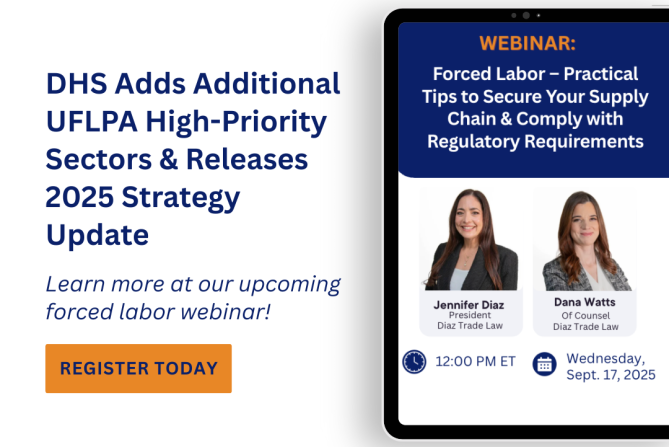
DHS Adds Additional UFLPA High-Priority Sectors; Releases UFLPA 2025 Strategy Update

Learn more about this update and all things UFLPA at our upcoming forced labor webinar on Sept. 17, 2025. Register here.

On August 19, 2024, the U.S. Department of Homeland Security (DHS) announced that it would be adding steel, copper, lithium, caustic soda, and red dates to the list of high-priority sectors for enforcement under the Uyghur Forced Labor Prevention Act (UFLPA). DHS also announced the release of an update to the UFLPA enforcement strategy.

Addition of High-Priority Sectors

Under the UFLPA, DHS is tasked with identifying high-priority sectors for enforcement. A high-priority sector designation indicates that entities in the sector have a higher risk of forced labor or state labor transfer of Uyghurs and other ethnic minorities from Xinjiang. 

In making the announcement of additional sectors, DHS cited each new addition’s connections to forced labor risks. For example, DHS stated that steel and copper have both been government-backed investment focal points in Xinjiang. Similarly, lithium is a government-identified key sector for investment and development in Xinjiang.

UFLPA Enforcement Strategy Update

DHS serves as the chair of the Forced Labor Enforcement Task Force (FLETF). Each year, the task force updates the UFLPA’s Strategy to Prevent the Importation of Goods Mined, Produced, or Manufactured with Forced Labor in the People’s Republic of China (UFLPA Strategy). The task force is statutorily required to provide annual updates […]

Go to Top