
tariffs

IEEPA Refund Class Certified: Why Importers With Significant Phase 3 Refunds Should Still File Their Own Suit 

By Jennifer Diaz and David Craven  |  October 2026 

On October 8, 2026, the U.S. Court of International Trade certified a nationwide class of importers of record that paid IEEPA duties and have not filed their own refund lawsuits, in Freestyle World, Inc. v. CBP, Ct. No. 26-01088. Certification does not issue refunds, and class members do not have access to CAPE Phase 3, which CBP opened on October 6 for finally liquidated entries of importers holding their own court orders. Importers with significant refunds on finally liquidated entries should weigh filing their own case now rather than waiting on the class. 

Key Takeaways 

  • On October 8, 2026, the U.S. Court of International Trade (CIT) certified a class of importers of record that paid IEEPA duties between February 1, 2025, and February 19, 2026, excluding any entity that separately filed its own refund action. 
  • Class certification is not a refund order. The CIT has not entered classwide relief, and further proceedings are pending. 
  • CBP deployed CAPE Phase 3 on October 6, 2026, for finally liquidated entries of importers that filed suit and hold court orders directing reliquidation. Class members do not currently have Phase 3 access through the class. 
  • As of October 19, 2026, the government had not appealed the class […]
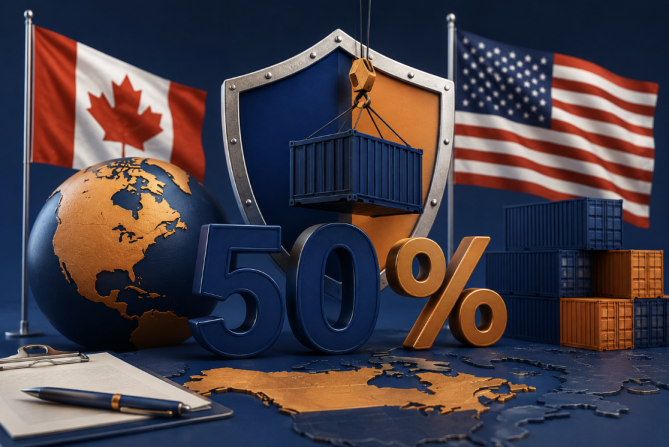
U.S.-Canada Tariff Escalation: New Section 338 Tariffs and Canadian Retaliatory Tariffs 

Effective August 22, 2026, the United States began imposing additional 50% tariffs on certain products of Canada under Section 338 of the Tariff Act of 1930. The duties were imposed through three Presidential Proclamations, issued on July 20, 2026, addressing alleged Canadian discrimination against U.S. products including dairy, alcoholic beverages, and motor vehicles. 

The tariffs were originally scheduled to take effect on August 19. On August 18, President Trump temporarily suspended their implementation for three days while negotiations with Canada continued, moving the effective date to 12:01 a.m. Eastern Time on August 22, 2026.  

That temporary reprieve has now expired, and U.S. Customs and Border Protection (CBP) has issued guidance explaining how importers, customs brokers, and filers should handle affected entries. 

What Is Section 338? 

Section 338 of the Tariff Act of 1930, codified at 19 U.S.C. § 1338, gives the President authority to impose additional duties of up to 50% when a foreign country discriminates against U.S. commerce or imposes certain unreasonable or unequal restrictions that place U.S. commerce at a disadvantage. 

Although Section 338 has existed for nearly a century, its use against Canada represents an unusual application of the statute.  

The 50% Tariffs Cover Far More Than Alcohol, Dairy, and Cars 

The July 20 proclamations invoked Section 338 in response to three categories of alleged Canadian discrimination: alcoholic beverages, dairy, and

By |2026-08-28T08:47:57-04:00August 28, 2026|tariffs|0 Comments

New Section 232 Proclamation Targets Imports of Unmanned Aircraft Systems 

On August 13, 2026, President Trump issued a new proclamation under Section 232 of the Trade Expansion Act imposing tariffs on certain imported unmanned aircraft systems (UAS) and their components. The Administration concluded that the United States’ dependence on foreign-manufactured UAS and critical UAS components threatens to impair national security by limiting the domestic industrial base and creating vulnerabilities in critical supply chains. 

The proclamation follows a Section 232 investigation conducted by the Department of Commerce, which found that imports have outpaced domestic production and that the United States remains heavily reliant on foreign suppliers. The Administration also cited concerns surrounding cybersecurity, and dependence on unreliable supply chains. 

What Does the Proclamation Do? 

The proclamation establishes a new tariff framework based on the type of unmanned aircraft system, and, in some cases, the country of origin: 

  • 100% tariffs on UAS with a maximum take-off weight of more than 25 kg 
  • 100% tariffs on UAS that integrate thermal imagers  
  • 100% tariffs on UAS docking stations  
  • 100% tariffs on certain critical UAS components as identified in Annex I.  
  • 25% tariffs on UAS with a maximum take-off weight of 25 kilograms or less […]
By |2026-08-17T09:39:05-04:00August 16, 2026|tariffs|0 Comments

DOJ Seeks to Vacate IEEPA Refund Injunctions 

Why Importers Who Haven’t Filed Suit Have the Most at Stake 

On August 10, 2026, the Department of Justice filed its opening brief in the consolidated Federal Circuit appeal challenging the Court of International Trade’s universal injunctions governing IEEPA duty refunds. The government’s own brief concedes that those injunctions now matter to exactly one group: importers with finally liquidated entries who have not filed suit. If the Federal Circuit vacates, that group has no administrative path to a refund, because CBP has told the court it lacks statutory authority to reliquidate finally liquidated entries on its own initiative. 

Key Takeaways 

  • The government filed its opening brief on August 10, 2026 in Federal Circuit Nos. 2026-1895, -1897, and -1899, appealing the CIT’s April 17, 2026 universal injunctions entered by Judge Richard K. Eaton. 
  • The government does not contest importer-specific reliquidation orders. It has stated it intends to comply with them and has not appealed the hundreds already entered. 
  • By the government’s own framing, the universal injunctions retain force only as to IEEPA refunds on finally liquidated entries belonging to importers who have not sued. 
  • CBP’s position is that Congress gave it no authority to reliquidate a finally liquidated entry absent a timely protest or reliquidation within 90 days of […]
By |2026-08-12T07:47:09-04:00August 12, 2026|Uncategorized|0 Comments

New Section 201 Safeguard Tariffs on Quartz Surface Products 

Short summary: President Trump’s new Section 201 safeguard measure establishes a four-year tariff-rate quota (TRQ) on imports of quartz surface products beginning August 15, 2026. While annual quota volumes gradually increase over the life of the measure, importers may face safeguard duties of up to 50% once quarterly quota allocations are exhausted, making careful planning essential.  

On July 31, 2026, President Trump issued a proclamation imposing a Section 201 safeguard measure on imports of quartz surface products (QSP). The measure takes the form of a four-year tariff-rate quota (TRQ) and applies to goods entered, or withdrawn from warehouse for consumption, on or after 12:01 a.m. Eastern Time on Saturday, August 15, 2026.   

If you import QSP, including countertops, backsplashes, vanity tops, bar tops, work tops, tabletops, flooring, wall facing, shower surrounds, fireplace surrounds, mantels, and tiles, this measure will likely affect your imports.  

How the Tariff-Rate Quota Works

A TRQ is not a flat tariff. A set volume of covered merchandise may enter each quota year at a lower in-quota rate under the new HTSUS heading 9903.45.30. Once that volume is exhausted, additional entries pay a substantially higher over-quota rate under new heading 9903.45.31.

The annual volume is divided into four equal quarterly tranches. Any unused portion of a quarterly tranche carries forward into the following quarter, and CBP is required to add the unused quantity to the next quarter’s total no later than 14 days after the prior quarter […]

By |2026-08-10T10:14:31-04:00August 8, 2026|tariffs|0 Comments
Go to Top