Section 301

$5.15 Million Settlement Highlights Growing Customs Enforcement Under the False Claims Act

Short summary: A Taiwanese manufacturer has agreed to pay $5.15 million to resolve allegations that it violated the False Claims Act by underpaying customs duties on imported goods. According to the Department of Justice, the company used improper customs practices to reduce duties owed to CBP, resulting in significant lost tariff revenue. The settlement underscores the federal government’s continued focus on customs enforcement and the growing use of the False Claims Act to pursue alleged duty evasion. 


The U.S. Department of Justice recently announced that a Taiwan-led manufacturer agreed to pay $5.15 million to resolve allegations under the False Claims Act and related administrative claims involving customs duties owed on imported goods. While the company did not admit liability, the settlement serves as another reminder that customs compliance remains a significant enforcement priority for the federal government. 

The Case – What Happened 

According to the DOJ, the alleged conduct went well beyond a simple classification error. The government alleged that the company used multiple methods over several years to reduce the customs duties it owed on imports. Specifically: 

  • Country of Origin Misrepresentations: From July 2018 through January 2022, Everlight allegedly knowingly misrepresented the country of origin on Chinese-manufactured LEDs. Everlight knew these products were manufactured in China, and then transshipped to Taiwan, before shipping them to the U.S.  Everlight allegedly misrepresented to CBP that the products originated in Taiwan rather […]
USTR Announces Section 301 Action Imposing New Tariffs on 60 Trading Partners 

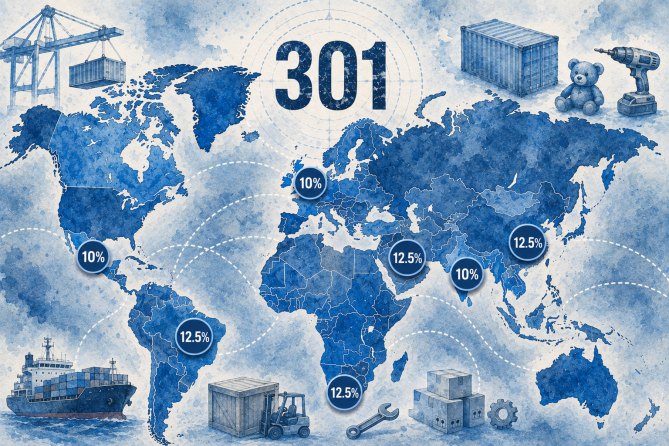
The Office of the U.S. Trade Representative (USTR) has announced a new Section 301 action imposing additional tariffs of 10% to 12.5% on imports from 60 economies that fail to prohibit or effectively enforce bans on goods produced with forced labor. The action covers the top 60 U.S. trading partners, representing 99.4% of U.S. imports, and took effect July 24, 2026. U.S. Customs and Border Protection (CBP) has issued entry filing guidance in CSMS #69326983, including the applicable Chapter 99 tariff headings. 

Key Takeaways 

  • Effective July 24, 2026, USTR imposed additional Section 301 duties of 10% or 12.5% on imports from 60 economies covering 99.4% of U.S. imports, based on findings that these economies failed to adopt or effectively enforce forced labor import prohibitions. 
  • CBP issued entry filing instructions in CSMS #69326983, including the Chapter 99 headings (9903.05.20 through 9903.06.21), reporting sequence, and Foreign Trade Zone admission requirements. 
  • Goods entered duty free under USMCA (Canada and Mexico) are exempt, as are CAFTA-DR textiles and apparel, Section 232 articles, civil aircraft, pharmaceutical articles, informational materials, and donations. There is also a list of miscellaneous products exempt no matter what their country of origin. 
  • An in-transit exception applies to goods loaded and in transit on the final mode before 12:01 a.m. ET on July 24, 2026, and entered before 12:01 a.m. ET on July 28, 2026. 

Why USTR Took […]

USTR Announces Section 301 Investigation into Nicaragua’s Acts, Policies, and Practices Related to Labor Rights, Human Rights, and the Rule of Law

The United States Trade Representative (USTR) announced the investigation regarding Nicaragua’s acts, policies, and practices related to labor rights, human rights, and the rule of law under Section 301 of the Trade Act of 1974. This is the first 301 investigation involving policies and practices that may violate labor rights and human rights.

301 Background

Section 301 of the Trade Act of 1974 is designed to address unfair foreign practices affecting U.S. commerce. It grants USTR a range of authorities to investigate unfair trade practices and to enforce U.S. rights under trade agreements.

Under 301, the U.S. government may impose trade sanctions on foreign countries that engage in acts that are burdensome to U.S. commerce or that violate trade agreements.

The law does not limit the scope of investigations, but it does mention several categories of activities that are subject to 301 action, including:

(1) a violation that denies U.S. rights under a trade agreement

(2) an “unjustifiable” action that “burdens or restricts” U.S. commerce

(3) an “unreasonable” or “discriminatory” action that “burdens or restricts” U.S. commerce.

“Commerce” is defined to include goods, services, and investment.

Previous examples of 301 investigations include investigations into China’s technology transfer practices, Vietnam’s currency manipulation, and Digital Services Taxes in various countries.

Nicaragua Investigation

The investigation into Nicaragua’s acts follows numerous credible reports that the Ortega-Murillo regime engages in human rights and labor rights violations and dismantling the rule of law. Activities cited by USTR include:

  • Politically-motivated arrests and imprisonments
  • Repression of members of religious groups and non-governmental organizations
  • […]

White House Announces Further Section 301 Tariff Hikes on Chinese Goods

Today the White House announced sweeping new tariffs on Chinese goods. The tariffs will apply to a range of sectors including semiconductors, steel and aluminum, batteries, and medical products.

Electric vehicles were a focus of the announcement, with tariffs to increase from 25% to 100% this year.

Impacted Industries

The new tariffs apply to $18 billion worth of Chinese imports in the following sectors:

  • Steel and aluminum – increase from 0-7.5% to 25% in 2024
  • Semiconductors – increase from 25% to 50% by 2025
  • Electric vehicles (TVs) – increase from 25% to 100% in 2024
  • Batteries
    • Lithium-ion EV batteries – increase from 7.5% to 25% in 2024
    • Lithium-ion non-EV batteries – increase from 7.5% to 25% in 2026
    • Battery parts – increase from 7.5% to 25% in 2024
    • Natural graphite and permanent magnets – increase from 0% to 25% in 2026
    • Certain critical minerals – increase from 0% to 25% in 2024
  • Solar cells – increase from 25% to 50% in 2024
  • Ship-to-shore cranes – increase from 0% to 25% in 2024
  • Medical products
    • Syringes and needles – increase from 0% to 50% in 2024
    • Certain PPE products – increase from 0-7.5% to 25% in 2024
    • Rubber medical gloves – increase from 7.5% to 25% in 2026

Why Now?

The announcement follows a statutorily required two-year government review of “Section 301” duties that were first imposed during the Trump Administration. The Special 301 review considers the current state of global IP protection and enforcement, unfair innovation policies, and market access barriers. In the […]

By |2024-05-14T11:19:37-04:00May 14, 2024|China|0 Comments

Customs and Trade Law Weekly Snapshot

Here is a recap of the latest customs and international trade law news:


[…]

Go to Top