Reasonable Care

CBP Protests and Post-Entry Corrections

Copyright 2025 Bloomberg Industry Group, Inc. (800-372-1033) Reproduced with permission. CBP Protests and Post-Entry Corrections

CBP is one of the most active federal enforcement bodies in international trade. CBP has broad authority to examine, detain, seize, and penalize imported goods, and it exercises that authority through an expanding set of tools.

Enforcement Mechanisms

CBP’s core enforcement mechanisms include:

  • Detention and Examination – Customs laws and regulations provide US Customs officers at all 328 ports of entry the ability to stop and search persons or merchandise and make admissibility decisions. Before goods are seized by CBP, they typically go through the detention process. CBP may detain any shipment for examination when it has reason to believe the goods may violate U.S. law.
  • Seizure and Forfeiture – When CBP suspects that goods violate U.S. law, it can seize the merchandise. The importer then faces a choice: file a petition for relief with CBP’s Fines, Penalties and Forfeitures Office (FP&F), offer a monetary settlement in lieu of forfeiture, abandon the goods, or contest the seizure through the administrative or judicial process.
  • Liquidation and Reliquidation – Every entry is subject to liquidation – the final determination of duties owed. CBP may liquidate an entry at a higher duty rate than originally estimated, triggering an unexpected duty bill. Importers have limited windows, generally within 180 days of liquidation, to challenge liquidation decisions.
  • Penalties – CBP has the authority to issue monetary penalties for violations of customs laws. These penalties may be assessed […]
By |2026-07-22T17:44:23-04:00July 22, 2026|Bloomberg Import|0 Comments

DOJ and DHS Publish Comprehensive Trade Fraud Enforcement Guide: What Importers Need to Know 

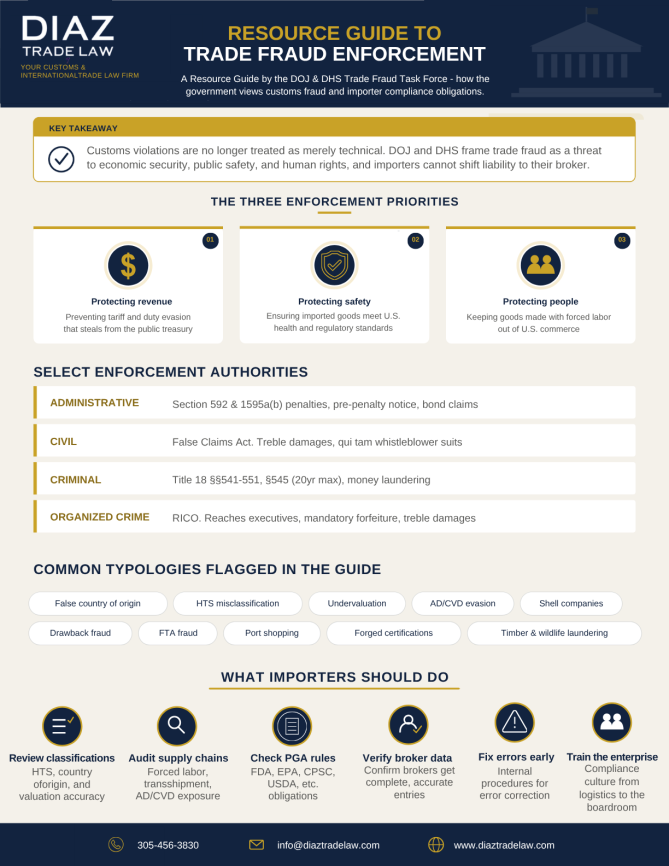
Short summary: The DOJ and DHS have jointly published a new Resource Guide to Trade Fraud Enforcement, highlighting the government’s coordinated approach to combating customs fraud and strengthening import compliance. The guide explains key enforcement authorities, common trade fraud schemes, and the government’s expectations for importers, customs brokers, and others participating in global supply chains.


The U.S. Department of Justice (DOJ) and Department of Homeland Security (DHS) have released a new 31-page Resource Guide to Trade Fraud Enforcement, providing one of the clearest public statements yet on how the federal government views customs fraud, enforcement priorities, and importer compliance obligations. The guide was developed by the Trade Fraud Task Force, a partnership that includes DOJ’s National Fraud Enforcement Division, Homeland Security Investigations (HSI), U.S. Customs and Border Protection (CBP), and other federal agencies. 

While much of the guide summarizes existing laws and enforcement authorities, its significance lies in the government’s messaging. It makes clear that customs violations are no longer viewed as merely technical or administrative issues. Instead, DOJ and DHS repeatedly characterize trade fraud as a threat to economic security, national security, public safety, and human rights, signaling that aggressive enforcement will continue across multiple agencies. 

Combatting Trade Fraud Is a Priority for the Federal Government 

One of the report’s primary themes is that trade fraud extends far beyond the underpayment of duties. According to the guide, fraudulent import practices undermine domestic manufacturers, deprive the government of […]

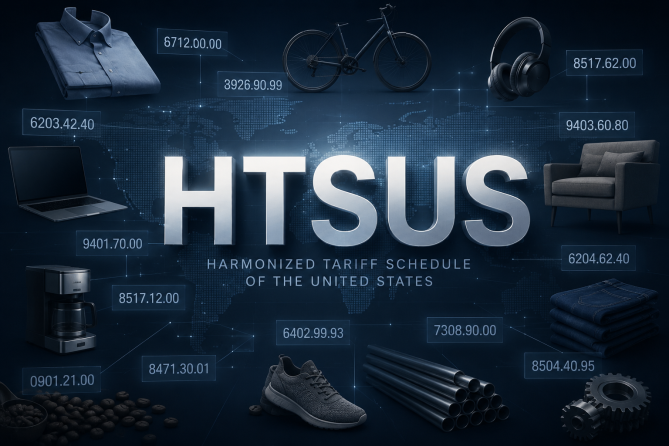
Understanding HTSUS Classification: Why Getting It Wrong Is Expensive

Summary: HTSUS classification determines the duty rate, applicability of tariffs such as Section 301 and Section 232, trade program eligibility, and helps determine whether any AD/CVD duties apply to every imported product. Misclassification often goes undetected for months or years, and since importers tend to reuse the same code for every entry of the same product, a single error can compound into significant back duties, penalties, and prior disclosure obligations. This article breaks down how classification errors happen, what reasonable care looks like, and how a documented classification process can prevent a small mistake from becoming a costly one. 


Every product entering the United States must be assigned a classification code under the Harmonized Tariff Schedule of the United States (HTSUS), and that ten-digit number determines far more than most importers realize. It sets the duty rate and tariffs owed on a shipment, flags whether a product needs additional agency review, and establishes whether it qualifies for preferential trade programs. A misclassification, even an unintentional one, can trigger back duties, penalties, and a prior disclosure process that could have been avoided entirely with the right classification from the start. 

What HTSUS Classification Actually Determines 

The Harmonized Tariff Schedule of the United States is the United States’ implementation of the international Harmonized System, a standardized numerical method of classifying traded products used by customs authorities around the world. Every entry filed with U.S. Customs and Border Protection (CBP) requires an HTSUS code, and […]

The U.S. Declined to Renew USMCA – What Importers Must Do Now

USMCA remains in force, but annual reviews create a new layer of origin compliance risk that importers can’t afford to ignore. 

KEY TAKEAWAYS 

  • USMCA did not end. On July 1, 2026, the U.S. declined to renew the agreement for a fresh 16-year term, moving it into annual reviews. The pact stays in force, potentially through 2036, unless a country formally exits with six months’ notice. 
  • Nothing changes at the port tomorrow. USMCA-qualifying goods still enter duty-free. Your certifications, rules-of-origin claims, and preference elections remain valid today. 
  • The real risk is enforcement, not policy. A decade of open renegotiation puts rules of origin, especially auto content and regional-value-content thresholds, into permanent play. Origin claims made under old assumptions become audit and penalty exposure. 
  • Act now on documentation, not headlines. Importers should stress-test USMCA certifications, tighten origin recordkeeping, and model exposure to Section 232 auto/steel/aluminum tariffs that already sit on top of the agreement. 

The Challenge: Compliance & Enforcement 

The news landed fast and loud: the United States declined to renew the U.S.-Mexico-Canada Agreement (USMCA) on July 1, 2026. U.S. Trade Representative Jamieson Greer confirmed the U.S. would forgo a fresh 16-year term in favor of annual reviews of the pact. Some coverage framed this as the end of North American free trade. It is not. 

Here is the […]

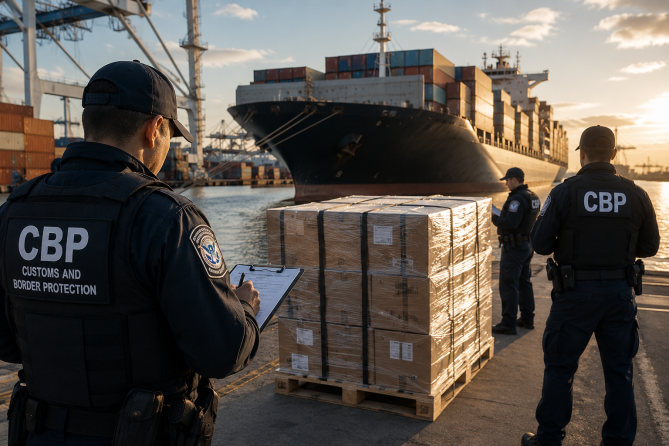
CBP Seized Your Goods at the Border: Your Options and Next Steps 

For more information on this topic, check out our webinar: ‘Goods Detained or Seized by CBP? Understand Your Options.” Watch here. 


Summary: When CBP seizes imported goods at the border, importers have several options — including filing a Petition, submitting an Offer in Compromise, or pursuing court action. This article explains the difference between detention and seizure, outlines the steps importers should take immediately after receiving a CBP Seizure Notice, and describes how a customs attorney can help recover seized merchandise and prevent future seizure. 


Importers expect the import process to run smoothly, but when a product is not compliant with U.S. laws and regulations, CBP is authorized under 19 CFR Part 162 and 19 CFR Part 151 to detain or seize goods upon importation. 

When goods arrive at a U.S. port of entry, CBP has the authority to detain a shipment if there is a question about its admissibility or compliance with U.S. laws and regulations. Detention is not the same as seizure. It is a temporary hold that gives CBP time to review the shipment and allows the importer to respond. During this window, a customs attorney can communicate directly with CBP on your behalf, provide the documentation or legal arguments needed to resolve the issue, and work to get your goods released before the situation escalates. 

If you do not respond effectively, CBP may move forward with a formal […]

Go to Top