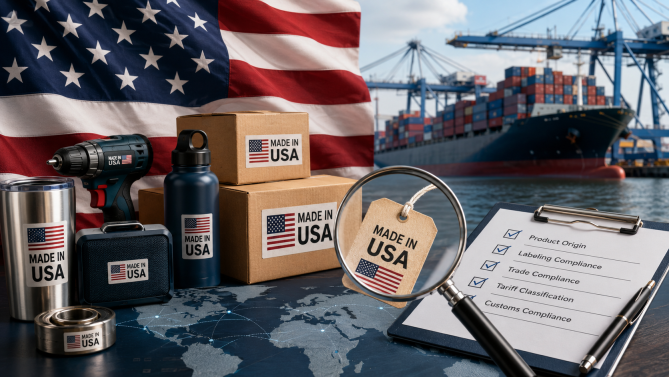
Made in USA

FTC Cracks Down on False “Made in the USA” Claims 

The Federal Trade Commission (FTC) recently announced law enforcement actions involving three companies that falsely claimed that their products were made in the United States.  

Made in the USA

The “Made in the USA” labeling rules were enacted to prevent deceptive advertising and ensure customers can make informed purchasing choices. The concept of labeling products with the correct country of origin dates all the way back to the McKinley Tariff Act in 1890, and Congress and federal agencies have updated “Made in the USA” rules over the years.  

FTC Jurisdiction 

The FTC is charged with preventing deception and unfairness in the marketplace. Under the FTC Act, the Commission may bring legal action against “false or misleading claims that a product is of U.S. origin”. The agency is authorized to issue a civil penalty of up to $40,654 per violation. 

The FTC has issued guidance on complying with the “Made in the USA” standard, most recently in 2021. View the latest guidance here.

When Can I Say Made in the USA? 

For a product to be considered as “Made in the USA” without qualification, that product must be “all or virtually all” made in the U.S. How the Commission determines whether a product is “all or virtually all” made in the U.S. is by looking at whether there was “a ‘reasonable basis’ to support the claim at the time it is made”. To prove […]

The Fine Line Between Transshipment and Substantial Transformation

Zero dollars or millions of dollars, that can be the difference in duties assessed depending on a country of origin determination.

Country of origin sounds simple – where did the product you are importing come from? However, in today’s global manufacturing market, this determination isn’t always straightforward.

Country of Origin & Substantial Transformation

Sometimes determining the country of origin is straightforward. If the entire product is born and bred in a single country, then that’s the country of origin. But what about when inputs from various countries are shipped to another country where they are then manufactured together into a finished product? This is when things can get a bit more complicated.

Many US Free Trade Agreements (FTAs) stipulate the precise amount of inputs that must be from the country in question in order to qualify for a special, lower (usually zero percent) duty rate. Other times, what happens to those inputs and in what country, regardless of where said inputs were originally from, is what matters. So, if you are sourcing inputs from China, and transforming them into a finished product in a Mexico, then Mexico will likely be the country of origin for the product.

But there’s a fine line here. Would snapping some Mexican door handles onto a car that is otherwise made in China, in Mexico, make it a car from Mexico? What if we painted the exterior? Put in the engine? Pursuant to 19 C.F.R. § 134.1(b), Customs will generally consider the 2nd country to be the […]

By |2024-07-26T12:11:40-04:00July 26, 2024|Import|0 Comments

Is “Made in the USA” Really Made in the USA?


Which Federal Agency Regulates the “Made in the USA” Claim?

The Federal Trade Commission (“FTC” or “the Commission”) “is charged with preventing deception and unfairness in the marketplace. The FTC created an Act that would allow the Commission to bring legal action “against false or misleading claims that a product is of U.S. origin”.

When Can I Say Made in the USA?

  • For a product to be considered as “Made in the USA” without qualification, that product must be “all or virtually all” made in the U.S. How the Commission determines whether a product is “all or virtually all” made in the U.S., by looking at whether there was “a ‘reasonable basis’ to support the claim at the time it is made”. To prove the “reasonable basis” standard, a manufacturer or marketer must provide “competent and reliable evidence” to the FTC.
  • A qualified Made in the USA claim must describe “the extent, amount or type of [its] domestic content or processing”. This allows the consumer to know “that the product isn’t entirely of domestic origin”. The FTC warns that qualified claims can be tricky, so it is best to “avoid qualified claims unless the product has a significant amount of U.S. content or U.S. processing”.
    • Ex: “60% U.S. content. Made in USA of U.S. and imported parts. Couch assembled in USA from Italian Leather and Mexican Frame.”
  • For a complete understanding of the FTC’s Made in the USA standard, take a look at “Complying with the MADE IN USA STANDARD”.

[…]

By |2026-06-05T07:37:00-04:00April 4, 2017|Best Practices, penalty, Pre-compliance|2 Comments
Go to Top