Forced Labor

CBP Issues Palm Oil WROs Against Two Indonesian Producers: What Importers Need to Know 

U.S. Customs and Border Protection (CBP) issued two Withhold Release Orders against palm oil and its derivative products produced in Indonesia by Mitra Aneka Rezeki and Hardaya Inti Plantation, directing detention of that merchandise at all U.S. ports of entry. The orders reach any importer whose palm oil or palm-derived inputs trace to either producer. Importers of food, personal care, cleanings, and industrial products should confirm whether either company sits anywhere in their supply chain. 

KEY TAKEAWAYS 

  • CBP issued two Withhold Release Orders (WROs) covering palm oil and its derivative products produced in Indonesia by Mitra Aneka Rezeki (MAR) and Hardaya Inti Plantation (HIP). CBP stated that, effective immediately, personnel at all U.S. ports of entry will detain that merchandise. 
  • CBP cited nine International Labour Organization (ILO) forced labor indicators at MAR and seven at HIP. With this action, CBP stated it now oversees and enforces 60 WROs and eight Findings under 19 U.S.C. § 1307. 
  • Under 19 C.F.R. § 12.43, an importer contesting a WRO detention submits tailored certificates of origin from the foreign seller or owner and a detailed statement from the ultimate consignee within 3 months after the date the article was imported stating that no forced labor was used in making the product. DTL’s read: that record takes longer to build than the deadline allows if the work starts at detention. 

What CBP Announced


According to CBP’s […]
USTR Announces Section 301 Action Imposing New Tariffs on 60 Trading Partners 

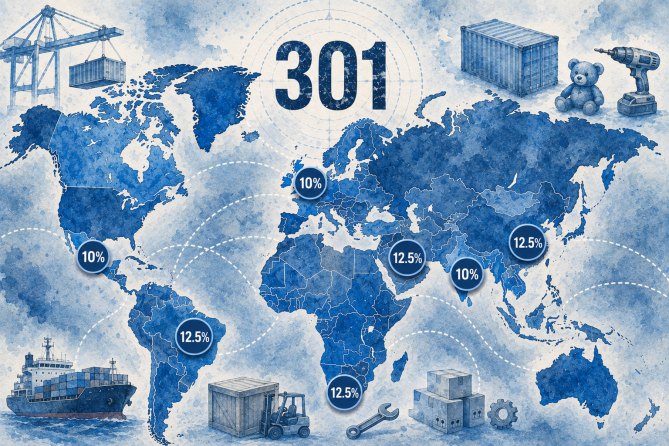
The Office of the U.S. Trade Representative (USTR) has announced a new Section 301 action imposing additional tariffs of 10% to 12.5% on imports from 60 economies that fail to prohibit or effectively enforce bans on goods produced with forced labor. The action covers the top 60 U.S. trading partners, representing 99.4% of U.S. imports, and took effect July 24, 2026. U.S. Customs and Border Protection (CBP) has issued entry filing guidance in CSMS #69326983, including the applicable Chapter 99 tariff headings. 

Key Takeaways 

  • Effective July 24, 2026, USTR imposed additional Section 301 duties of 10% or 12.5% on imports from 60 economies covering 99.4% of U.S. imports, based on findings that these economies failed to adopt or effectively enforce forced labor import prohibitions. 
  • CBP issued entry filing instructions in CSMS #69326983, including the Chapter 99 headings (9903.05.20 through 9903.06.21), reporting sequence, and Foreign Trade Zone admission requirements. 
  • Goods entered duty free under USMCA (Canada and Mexico) are exempt, as are CAFTA-DR textiles and apparel, Section 232 articles, civil aircraft, pharmaceutical articles, informational materials, and donations. There is also a list of miscellaneous products exempt no matter what their country of origin. 
  • An in-transit exception applies to goods loaded and in transit on the final mode before 12:01 a.m. ET on July 24, 2026, and entered before 12:01 a.m. ET on July 28, 2026. 

Why USTR Took […]

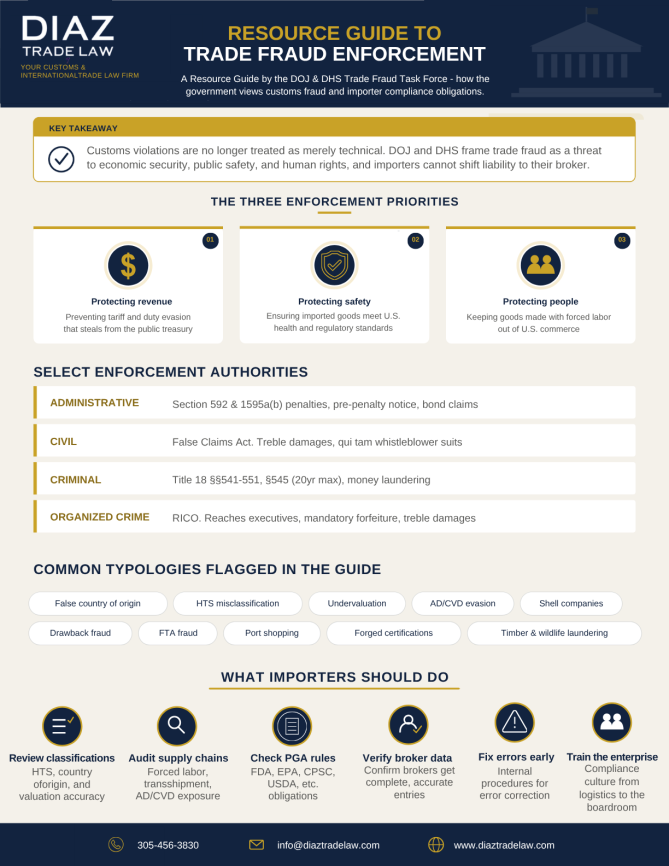
DOJ and DHS Publish Comprehensive Trade Fraud Enforcement Guide: What Importers Need to Know 

Short summary: The DOJ and DHS have jointly published a new Resource Guide to Trade Fraud Enforcement, highlighting the government’s coordinated approach to combating customs fraud and strengthening import compliance. The guide explains key enforcement authorities, common trade fraud schemes, and the government’s expectations for importers, customs brokers, and others participating in global supply chains.


The U.S. Department of Justice (DOJ) and Department of Homeland Security (DHS) have released a new 31-page Resource Guide to Trade Fraud Enforcement, providing one of the clearest public statements yet on how the federal government views customs fraud, enforcement priorities, and importer compliance obligations. The guide was developed by the Trade Fraud Task Force, a partnership that includes DOJ’s National Fraud Enforcement Division, Homeland Security Investigations (HSI), U.S. Customs and Border Protection (CBP), and other federal agencies. 

While much of the guide summarizes existing laws and enforcement authorities, its significance lies in the government’s messaging. It makes clear that customs violations are no longer viewed as merely technical or administrative issues. Instead, DOJ and DHS repeatedly characterize trade fraud as a threat to economic security, national security, public safety, and human rights, signaling that aggressive enforcement will continue across multiple agencies. 

Combatting Trade Fraud Is a Priority for the Federal Government 

One of the report’s primary themes is that trade fraud extends far beyond the underpayment of duties. According to the guide, fraudulent import practices undermine domestic manufacturers, deprive the government of […]

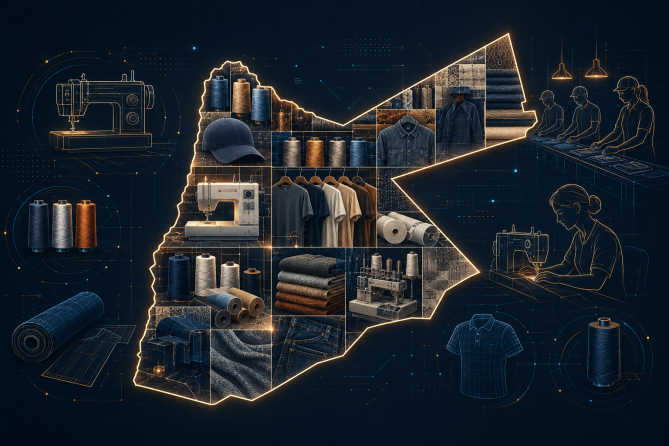
CBP Issues Two New WROs Against Jordan Garment Factories: What Importers Need to Know

Why importers who diversified out of China to FTA partners are now squarely in CBP’s forced-labor crosshairs — and the five-step package you need before your first detention notice. 


Short summary: CBP just issued two Withhold Release Orders against garment factories in Jordan, a U.S. free trade agreement partner. If you diversified out of China, thinking that solved your forced-labor exposure, this action is your wake-up call. Duty-free status is not a compliance shield. For apparel and textile importers, the window to build a defensible admissibility package is now, before a detention notice arrives. 


On June 23, 2026, U.S. Customs and Border Protection (CBP) issued two Withhold Release Orders (WROs) against garments produced by Needle Craft Ltd. and Casual Wear Apparel LLC — two garment-manufacturing factories in Jordan. Effective immediately, CBP will detain all garments produced by these two factories at every U.S. port of entry. These are the fifth and sixth WROs of fiscal year 2026, and they push CBP’s active enforcement docket to 58 WROs and eight Findings under 19 U.S.C. § 1307. 

If you read only one sentence of this post, read this one: the country you moved your sourcing to to escape China-related forced-labor risk is not safe by virtue of being a U.S. trade-preference partner. Jordan Apparel enters the United States duty-free under the U.S.–Jordan Free Trade Agreement and […]

By |2026-06-23T12:22:53-04:00June 23, 2026|Forced Labor|0 Comments

Forced Labor Enforcement Just Crossed a Border: What CBP’s Serbia Copper WRO Means for Your Supply Chain

Key Takeaways 

  • CBP continues to chase the company, not just the country. Zijin’s parent was already on the UFLPA Entity List for forced labor in China; this Withhold Release Order (WRO) hits its Serbian copper operation on a separate evidentiary basis. Moving production to a “friendly” country does not move you out of CBP’s reach. 
  • Copper just joined the enforcement map. Forced-labor detentions are no longer concentrated in apparel, solar, and cotton. If you import copper—or anything containing it—your supply chain is now in scope, and most copper-reliant importers have done zero forced-labor due diligence. 
  • The burden is on you, and it lands the moment your shipment is detained. Under a WRO, there is no notice and no grace period. You either prove your goods are clean by detailed documentary evidence, or you export or destroy them. 

On June 16, 2026, U.S. Customs and Border Protection (CBP) issued a Withhold Release Order against copper and copper products manufactured in Serbia by Serbia Zijin Copper D.O.O.—the fourth WRO of Fiscal Year 2026 and the second targeting a Serbian operation in roughly six months. Effective immediately, CBP personnel at every U.S. port of entry will detain shipments of copper and copper products from this company. 

If you read that as another distant enforcement headline, you are missing the part that should concern you. This […]

Go to Top