AD/CVD

New AD/CVD Case Filed Against Corrugated Pizza Boxes From China, Malaysia, and Turkey   

A new antidumping and countervailing duty action has been filed against corrugated pizza boxes From China, Malaysia, and Turkey. The allegation is that imports from China, Malaysia, and Turkey are unfairly subsidized and are being dumped.  

Full list of exporters here. 

Full list of importers here.  

Background on AD/CVD Investigations 

Antidumping duty (“AD”) and countervailing duty (“CVD”) investigations are brought jointly by the U.S. International Trade Commission (“USITC”) and the U.S. Department of Commerce (“Commerce”). AD investigations are triggered when a domestic industry alleges that it has been injured by competing imports of particular goods from specific countries being sold at less than a fair value. Meanwhile, CVD investigations are triggered when a domestic industry alleges that it has been injured by competing imports that are being unfairly subsidized by their governments. The domestic industry initiating the investigation is known as the petitioner while the foreign industry participating in the investigation is known as the respondent.  

Scope of the Investigation 

The merchandise covered by these investigations is certain corrugated food service boxes, commonly known as pizza boxes, regardless of shape.  

The product subject to the investigation is currently classified in the Harmonized Tariff Schedule of the United States (HTSUS) under the subheading: 4819.10.0020.  

Next Steps 

The Commerce Department will determine whether to initiate the investigations within 20 days. The USITC will reach a preliminary determination of material injury or […]
By |2026-09-14T17:24:03-04:00September 14, 2026|AD/CVD, U.S. Department of Commerce (DOC)|0 Comments

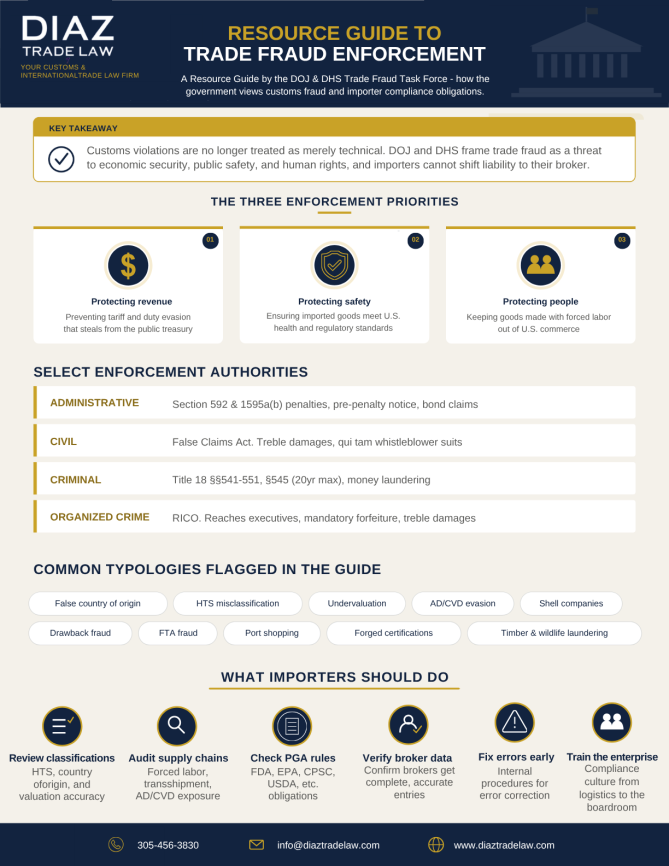
DOJ and DHS Publish Comprehensive Trade Fraud Enforcement Guide: What Importers Need to Know 

Short summary: The DOJ and DHS have jointly published a new Resource Guide to Trade Fraud Enforcement, highlighting the government’s coordinated approach to combating customs fraud and strengthening import compliance. The guide explains key enforcement authorities, common trade fraud schemes, and the government’s expectations for importers, customs brokers, and others participating in global supply chains.


The U.S. Department of Justice (DOJ) and Department of Homeland Security (DHS) have released a new 31-page Resource Guide to Trade Fraud Enforcement, providing one of the clearest public statements yet on how the federal government views customs fraud, enforcement priorities, and importer compliance obligations. The guide was developed by the Trade Fraud Task Force, a partnership that includes DOJ’s National Fraud Enforcement Division, Homeland Security Investigations (HSI), U.S. Customs and Border Protection (CBP), and other federal agencies. 

While much of the guide summarizes existing laws and enforcement authorities, its significance lies in the government’s messaging. It makes clear that customs violations are no longer viewed as merely technical or administrative issues. Instead, DOJ and DHS repeatedly characterize trade fraud as a threat to economic security, national security, public safety, and human rights, signaling that aggressive enforcement will continue across multiple agencies. 

Combatting Trade Fraud Is a Priority for the Federal Government 

One of the report’s primary themes is that trade fraud extends far beyond the underpayment of duties. According to the guide, fraudulent import practices undermine domestic manufacturers, deprive the government of […]

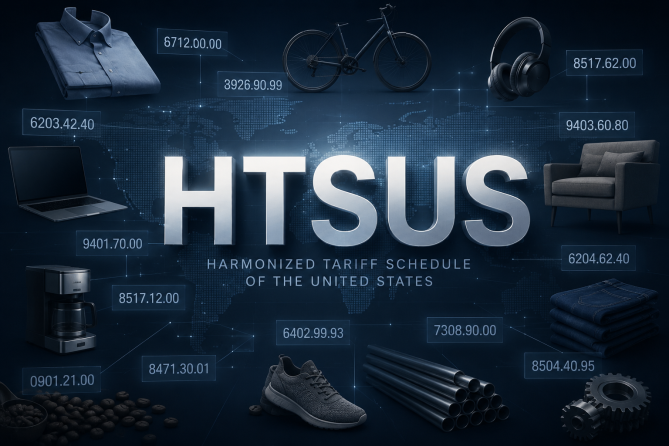
Understanding HTSUS Classification: Why Getting It Wrong Is Expensive

Summary: HTSUS classification determines the duty rate, applicability of tariffs such as Section 301 and Section 232, trade program eligibility, and helps determine whether any AD/CVD duties apply to every imported product. Misclassification often goes undetected for months or years, and since importers tend to reuse the same code for every entry of the same product, a single error can compound into significant back duties, penalties, and prior disclosure obligations. This article breaks down how classification errors happen, what reasonable care looks like, and how a documented classification process can prevent a small mistake from becoming a costly one. 


Every product entering the United States must be assigned a classification code under the Harmonized Tariff Schedule of the United States (HTSUS), and that ten-digit number determines far more than most importers realize. It sets the duty rate and tariffs owed on a shipment, flags whether a product needs additional agency review, and establishes whether it qualifies for preferential trade programs. A misclassification, even an unintentional one, can trigger back duties, penalties, and a prior disclosure process that could have been avoided entirely with the right classification from the start. 

What HTSUS Classification Actually Determines 

The Harmonized Tariff Schedule of the United States is the United States’ implementation of the international Harmonized System, a standardized numerical method of classifying traded products used by customs authorities around the world. Every entry filed with U.S. Customs and Border Protection (CBP) requires an HTSUS code, and […]

New AD/CVD Case Filed Against Glyphosate from China 

A new antidumping and countervailing duty action has been filed against Glyphosate from China. The allegation is that imports from China are being dumped and unfairly subsidized.  

Full list of importers here.
Full list of exporters here. 

Background on AD/CVD Investigations 

Antidumping duty (“AD”) and countervailing duty (“CVD”) investigations are brought jointly by the U.S. International Trade Commission (“USITC”) and the U.S. Department of Commerce (“Commerce”). AD investigations are triggered when a domestic industry alleges that it has been injured by competing imports of particular goods from specific countries being sold at less than a fair value. Meanwhile, CVD investigations are triggered when a domestic industry alleges that it has been injured by competing imports that are being unfairly subsidized by their governments. The domestic industry initiating the investigation is known as the petitioner, while the foreign industry participating in the investigation is known as the respondent. 

Scope of the Investigation 

The merchandise covered by these investigations is glyphosate (N(phosphonomethyl) glycine) in all forms, concentrations, and formulations.  

The products subject to the investigation are currently classified in the Harmonized Tariff Schedule of the United States (HTSUS) under the following subheadings: 2931.49.0020, 3808.93.5020, and 2931.49.0080.  

Full scope here.

Next Steps 

The Commerce Department will determine whether to initiate the investigations within 20 days. The […]

By |2026-07-02T07:40:26-04:00July 2, 2026|AD/CVD, China, Import|0 Comments

EAPA Update: CBP Finds Evasion Despite Full Cooperation 

A recent EAPA evasion finding against a solar importer reveals how a single country-of-origin misclassification can trigger steep consequences, even when the importer fully cooperates with CBP.

KEY TAKEAWAYS 

  • CBP issued a Notice of Determination as to Evasion in an EAPA case, finding that a major solar-module importer evaded antidumping AD/CVD orders on crystalline silicon photovoltaic cells. 
  • Report the cell, not the module.  For solar modules assembled in a third country, the AD/CVD-relevant country of origin is where the cell was made, not where the module was assembled. Declaring the assembly country can be a material, false statement under EAPA. 
  • Cooperation does not erase the duty.  The company fully cooperated, but CBP found evasion anyway. 
  • The exposure is severe.  Cash-deposit rates reached up to 271.28% (Vietnam AD) and 238.95% (China-wide AD).
  • If you assemble abroad and import into the U.S., audit your country-of-origin declarations now — before an allegation does it for you. 

The Evasion Case 

On June 23, 2026, U.S. Customs and Border Protection (CBP) issued a Notice of Determination as to Evasion in EAPA Consolidated Case No. 8163, finding substantial evidence that a major solar-module importer evaded antidumping (AD) and countervailing (CVD) duty orders on crystalline silicon photovoltaic cells. The finding reached the Vietnam Circumvention Determination and the Malaysia and Vietnam AD/CVD Orders. 

The […]

Go to Top